The Reopening That Wasn't
Iran opened the Strait of Hormuz Friday. By Saturday morning, strict control was back. Markets printed all-time highs in between — and the tape was ignoring fundamentals before that, too.

Friday morning, Iran's foreign minister announced that the Strait of Hormuz was "completely open" to commercial shipping.
Markets ripped. U.S. crude oil plunged 11.4% to $83.85 per barrel — its lowest level since early March. Brent crude fell 9% to $90.38. Heating oil, which is a close cousin of jet fuel, dropped 13%. The S&P 500 and the Nasdaq both opened at all-time highs.
Before Friday's closing bell, the crack in the story was already visible. Iran's parliamentary speaker publicly contradicted the Trump administration's framing of the announcement. Ship-tracking data showed tankers attempted to exit the waterway and were turned back by Iranian forces. A maritime analyst on the desk at ship-tracking firm Kpler was direct: the ships had clearly not been given approval to pass.
By 5:07 AM Eastern this morning — less than twenty-four hours after Iran's initial statement — Iran's Khatam al-Anbiya military command had reimposed "strict control" over the strait. The reopening, in the command's own words, had "returned to its previous state." It will remain that way, they said, until the United States lifts its naval blockade of Iranian ports.
So here is where Saturday actually leaves us.
The strait is not open. The U.S. blockade is not lifted. Markets repriced to all-time highs yesterday on a peace that didn't survive a weekend.
This is a useful moment to think carefully about what the market is actually doing right now.
The Supply Chain That Wasn't Going to Snap Back Anyway
Set aside the walkback for a minute. Imagine the Friday reopening had held.
It still wouldn't have fixed the physical oil market quickly, and the reasons matter.
Roughly 170 million barrels of oil remain trapped in the Persian Gulf, unable to reach buyers. War-risk insurance premiums for Hormuz transits — which peaked at 2.5% of a ship's hull value in March, up from 0.125% pre-war — have eased to somewhere between 0.8% and 1%. That sounds better until you remember it is still six to eight times the pre-crisis norm. Major reinsurers withdrew war-risk coverage entirely earlier in the crisis, and the firms writing new policies need to see peace hold for weeks, not hours, before rates normalize. Mines that Iran reportedly planted in the strait are still being cleared. And even Iran's Friday "opening" was partial on its own terms: non-military vessels only, on a coordinated route, with permission from the Islamic Revolutionary Guard Corps Navy.
The product most exposed to all of this is jet fuel.
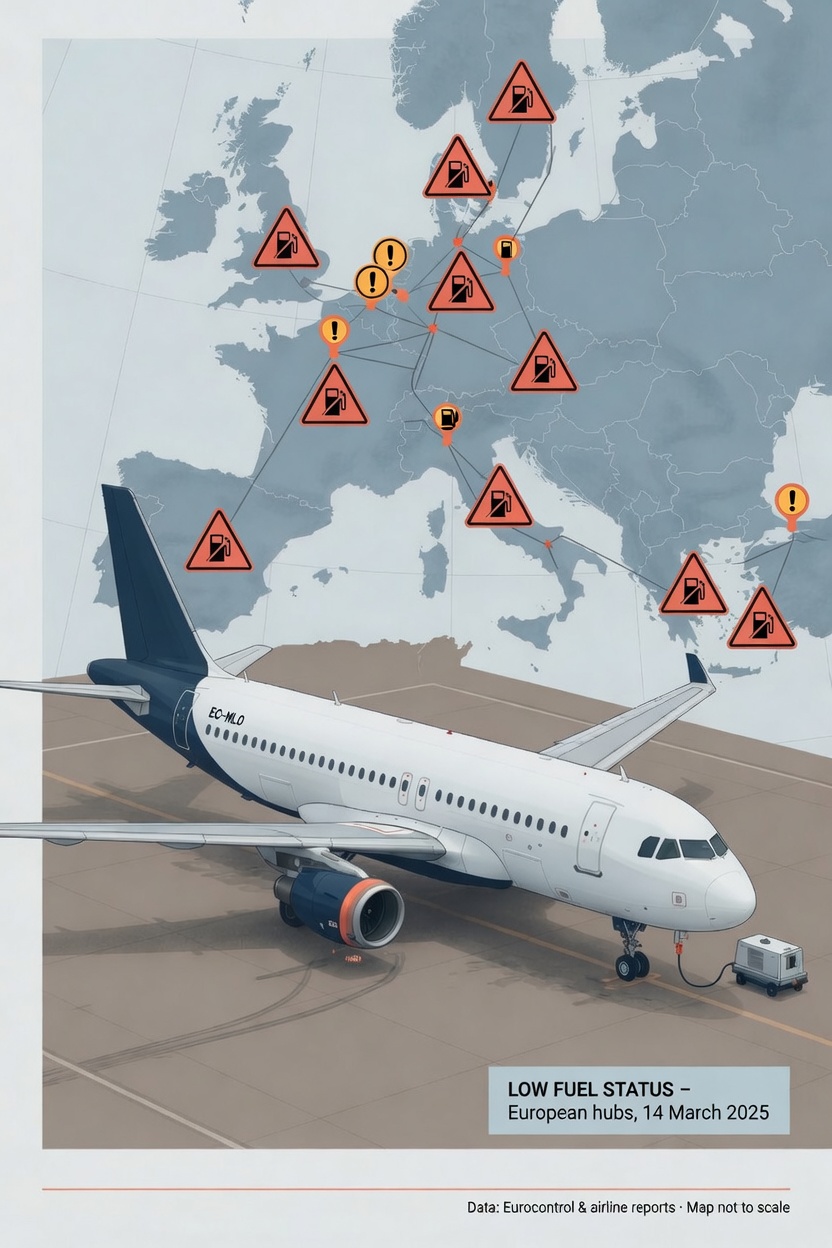
About 40% of the world's jet fuel supply passes through the Strait of Hormuz. For Europe, the figure is 75%. The director of the International Energy Agency told the Associated Press this week that Europe has roughly six weeks of jet fuel left before rationing becomes unavoidable. Some European countries are carrying only eight to ten days of strategic reserves. Jet fuel prices have already doubled in Europe and are up roughly 95% in the United States since the war began.
The downstream effects are already visible — and they are no longer confined to Europe. Four Italian airports — Bologna, Milan, Treviso, and Venice — have placed restrictions on refueling. KLM has cut 160 European flights for next month. easyJet expects a pretax loss of more than $700 million for the first half of its fiscal year. Lufthansa is shutting its feeder airline CityLine down early. Ryanair's CEO expects summer flight cancellations of 5 to 10%.
The crisis reached North America on Friday. Air Canada — Canada's flag carrier — announced it is suspending all service from Toronto and Montreal to New York's JFK airport from June 1 through October 25. Nearly five months of a cross-border route into one of the largest airports in the United States, gone. JFK is one of six routes the airline is cutting outright, alongside broader capacity reductions of 1% in April and 3% in May. The airline's public explanation was direct: jet fuel prices have doubled since the Iran conflict began, and the economics of the route no longer work. A supply chain that starts in the Persian Gulf has just made a U.S.-Canada route unworkable into the summer travel season.
This matters for more than vacation plans. Air freight — which moves a disproportionate share of high-value global cargo, from pharmaceuticals to semiconductors to just-in-time manufacturing inputs — runs on the same jet fuel. When that fuel doubles in price and tightens in supply, the cost shows up in everything that flies. Which then shows up in the inflation numbers, with a lag. The Federal Reserve, already boxed in by stagflation risk, has one more input pushing the wrong direction at exactly the wrong time.
None of this resolves on a Friday headline, even if the Friday headline had been durable. A genuine normalization of Hormuz shipping is a third-quarter story at the earliest. More realistically, it stretches into the second half of the year. The market priced an April resolution on Friday. The ships would have taken months even if Iran hadn't walked it back overnight.
The Tape Wasn't Trading Fundamentals Before Friday Either
Here is the part worth lingering on, because it will still matter long after this particular crisis has cleared.
In the ten trading days leading into Friday's headline, the S&P 500 rallied roughly 9.8%. That is a 99th-percentile ten-day move by any historical measure. You do not get returns of that magnitude from fundamentals improving. You get them from positioning unwinding.
Everyone Was Short. Then They Weren't.
Institutional positioning data from major prime brokers tells the cleanest version of the story. Two weeks ago, retail options traders were loaded up on puts at the lows — the market was priced for more downside. By Friday, that positioning had flipped completely. One widely-watched hedge fund positioning tracker reported retail call-buying in the 90th percentile on a single up day. Long/short hedge funds, meanwhile, had been running their lowest net equity exposure since the COVID crisis heading into the rally. Every one of them was positioned for the tape to keep breaking down. They got squeezed instead.
A Shoe Company Becomes a GPU Company
While that was happening, the narrative side of the market produced a genuinely remarkable specimen. Allbirds — a struggling direct-to-consumer shoe company that went public in 2021 and has since lost most of its market capitalization — announced a $50 million convertible financing. The purpose of the raise was not to sell more shoes. The purpose was to pivot the company into artificial intelligence compute infrastructure. The stock ripped on the announcement.
You do not need to have an opinion on AI to have an opinion on that transaction. A shoe company announced it was becoming a GPU company, and investors rewarded the announcement itself. That is not fundamentals. That is narrative premium — the same dynamic that made crypto-treasury corporate pivots work for a brief window a few years ago, now being applied to compute.
A Squeeze, a Flip, and a Pivot
Put the pieces together. A bearish hedge-fund community getting squeezed. Retail options traders flipping from extreme put-buying to extreme call-chasing. Failing companies being rewarded for cosmetic AI pivots. What you see is a tape running on flows and narrative, not on fundamentals.
Then Friday's Hormuz headline hit, and the pre-loaded squeeze fired on top of it. Then overnight, the headline itself came apart.
This is what the market is right now. Not what it says about itself — what it actually is.
What This Means for Your Retirement
If you are within ten years of retirement, this is the environment your financial plan needs to be stress-tested against.
The math is unforgiving. A 50% loss requires a 100% gain just to recover. Drawdowns during your fragile decade — the five years before retirement and the five years after — are the single biggest threat to the entire retirement plan. And the most damaging kind of drawdown is the one you walk into because you chased a headline that looked clean and turned out to be wrong.
A trader sees Friday's all-time highs and buys the breakout. That is their job. They can afford to be wrong, because they have decades of earning power to recover if they are.
A fiduciary — an advisor legally obligated to put your interests ahead of their own — sees Friday's ATHs on top of Saturday's walkback, on top of a jet fuel crisis that hasn't resolved, on top of a rally driven by positioning rather than earnings — and says no. Not because the fiduciary is pessimistic. Because the fiduciary's job is not to chase the tape. The fiduciary's job is to make sure your retirement does not get whipsawed by a reopening that lasted less than a day.
The distinction between those two jobs is not academic. It is the difference between retiring on your timeline and retiring on the market's.
Friday's all-time highs on top of Saturday's walkback, on top of a jet fuel crisis that hasn't resolved, on top of a rally driven by positioning rather than earnings — that is exactly the kind of environment a fiduciary exists to navigate.
What We're Doing About It
At Asset Guidance Group, the investment approach is rules-based and automated. The system monitors risk signals across markets continuously — every thirty minutes of every trading day. When conditions change, positioning adjusts, based on tested rules applied across eighteen years of historical market data. Not based on headlines. Not based on how anyone is feeling that morning.
That means we are not buying Friday's euphoria. We are not panicking into Saturday's walkback. We are not rebuilding portfolios around a jet fuel shortage that may deepen or a ceasefire that may or may not hold. The system is designed for exactly this kind of environment: noisy, flow-driven, narrative-saturated, and full of headlines that don't survive the weekend.
What That Discipline Looks Like From the Inside
I will tell you what it looked like from my chair this week, because I think it matters.
I felt the pull. Watching the tape rip higher day after day, my trader instincts were firing hard. I wanted to add positions. Several candidates on our watch list were a fractional hair from our entry thresholds, and the emotional part of me wanted to loosen the rules just enough to get in — to not sit still while the market melted up.
Here is what I did instead. I looked at what the system was actually saying, across every model — from the most conservative retirement-account framework to the most aggressive speculative one. The message was the same in each case: this is not the moment to add. My manual chart indicators agreed, and they were emphatic about it. Severely overbought. Take profit. Death crosses. The kind of extreme statistical positioning where a reversion to the mean is not a question of if but when.
I built those rules. I backtested them across eighteen years of real market data. I know exactly why each threshold is where it is. And when your own rules tell you no, and your own indicators tell you no, and your own models across every risk tier tell you no — the right answer is no. Even when — especially when — it feels wrong.
That is what fiduciary duty looks like in practice. Not a line on a website. A decision, made in real time, to honor the discipline over the impulse. Your retirement is what the discipline is built to protect.
I am not a permabear. I am a professional with aggressive instincts, trained for decades to see opportunity and move on it. What I am also is duty-bound to put client interests ahead of my own inclinations. That is the whole job. Building the rules is the easy part. Yielding to them when your gut is screaming the other direction — that is the part clients are paying for.
Discipline over headlines. Rules over reaction. The same standard on Friday, Saturday, and the Monday after.
The Iran war will eventually end. The jet fuel market will eventually normalize. The positioning squeezes will eventually unwind. None of that is in doubt on a long enough timeline. The question for someone in the fragile decade is whether your portfolio arrives at that long timeline in one piece — or whether it takes a hit along the way that it cannot recover from.
That is the question a fiduciary exists to answer.
Before You Close This Tab
If you are reading this on Substack, hit the ❤️ heart icon, drop a comment with what you want to see covered next, and share this post with someone who's been watching the last forty-eight hours and wondering what any of it means. If you haven't already, subscribe to The Lighthouse — it's free.
Curious how a rules-based, continuously monitored approach handles a market like this one? Our ATS management page walks through the philosophy: assetguidancegroup.com/ats-mgmt-landing-page-347034
If the last forty-eight hours have you rethinking your own positioning — or wondering whether your current advisor is doing anything beyond checking a quarterly box — let's have that conversation. Reply to this post, call the office, or schedule a review here.
Reach us: [email protected] | assetguidancegroup.com/calendar
───This post originally appeared on The Lighthouse on Substack — weekly financial analysis written specifically for people within ten years of retirement. Subscribe free at [The Lighthouse on Substack] or upgrade for weekly Trades of the Week picks.───
Investing involves risk, including the possible loss of principal. This article is for informational purposes only and does not constitute personalized investment advice. Past performance is not indicative of future results.
Wallace R Nichols, MBA, JD, CFP Chief Investment Officer Asset Guidance Group, LLC, a registered investment advisor