In a World of Our Own
The S&P just posted a rally so rare it has only happened twice before since 1980 — and none of the usual reasons for one are present. Here's what I see when I look at it.
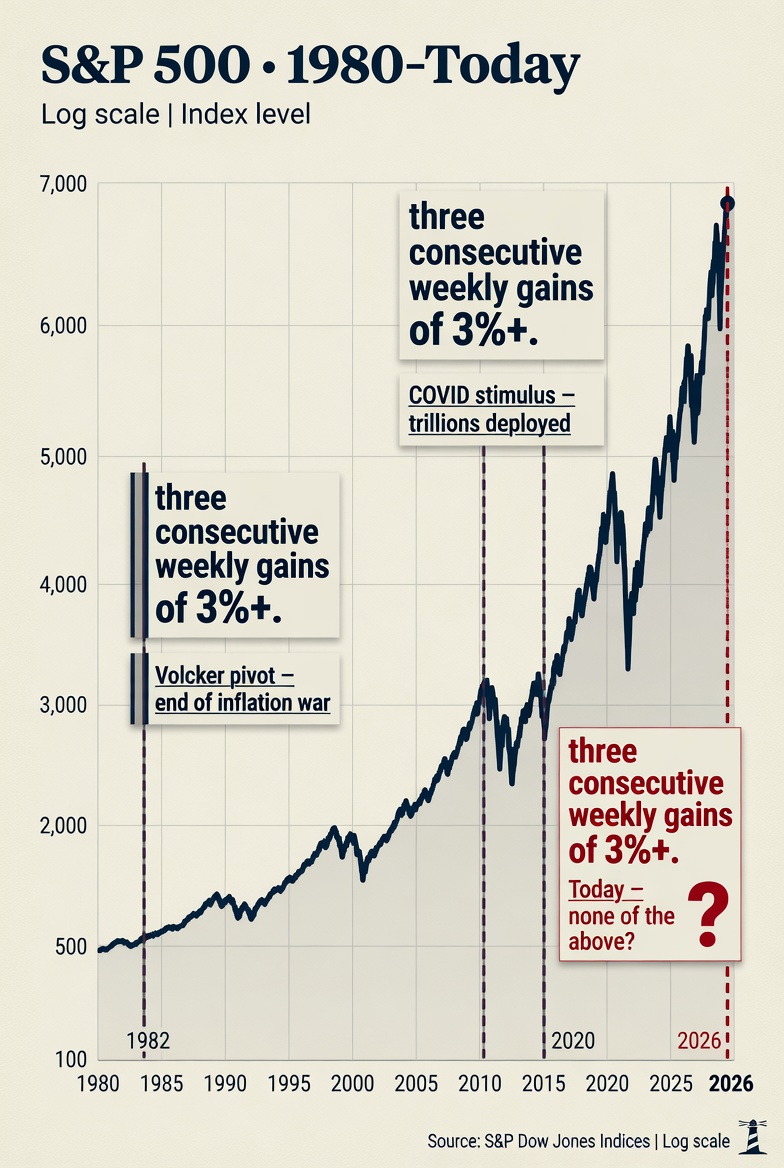
The US stock market just did something remarkable. Something that deserves attention — whether this rally has you feeling vindicated or whether it is leaving you deeply uneasy.
Three consecutive weeks of gains above 3%. The S&P 500 up 3.36%, then 3.56%, then 4.54%. That has only happened three times since 1980.
The other two? 1982, when the Federal Reserve finally broke the back of double-digit inflation after a years-long fight. And 2020, when the government and the Fed threw trillions of dollars at an economy frozen by COVID.
Both previous times came after deep bear markets, with massive policy stimulus driving the recovery. Today we have neither. The S&P never even fell a full 10% from its highs before this rally started. The Fed is not racing to cut rates. The Iran war is not over. Oil is still elevated. Treasury yields are still higher than they were before the Strait of Hormuz crisis began.
A Bloomberg columnist I read regularly described the recent price action perfectly: it looks like "a ball held under water finally released." Once the worst fears about the Gulf started to ease, the buying pressure that had been building simply exploded to the surface.
Foreign investors keep asking me: how are US investors so able to ignore the events in the Persian Gulf? US investors with long memories are asking a sharper version of the same question: what the hell is going on?
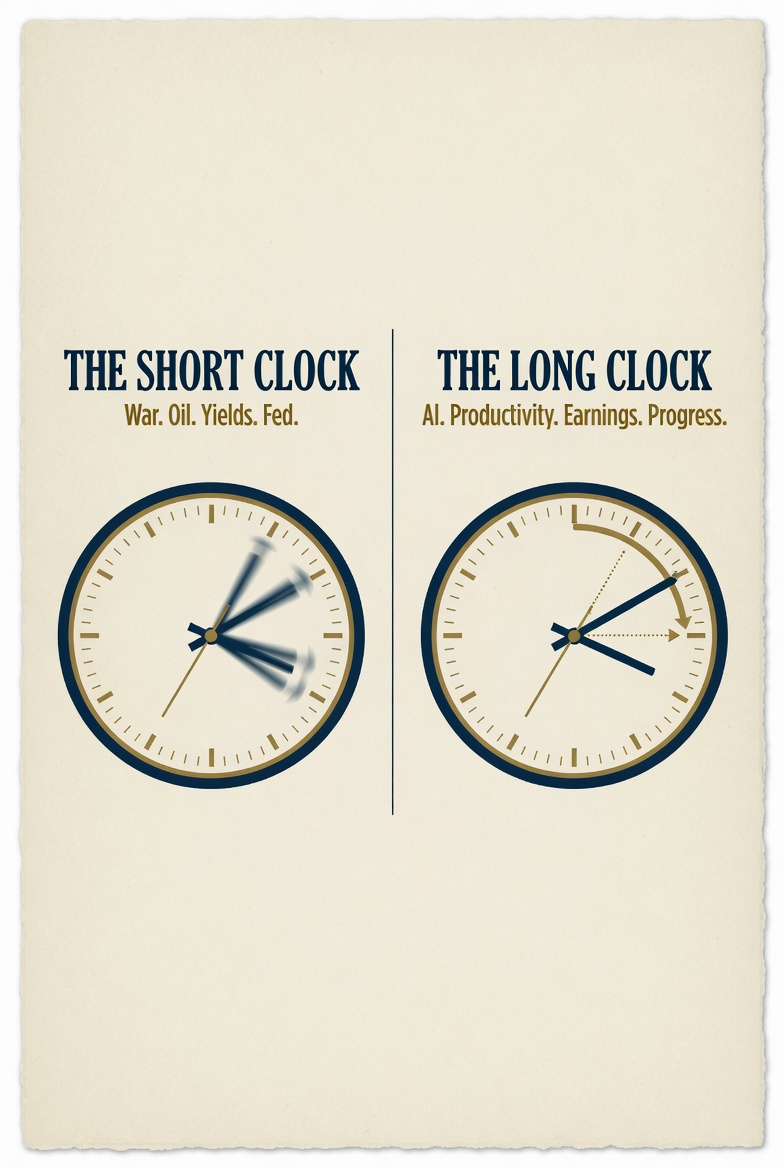
The plain answer is that American markets are running in a world of our own right now — and whether that world is sustainable depends on how you read two very different clocks.
What Happened
The Old Drivers Are Missing
Let's start with the facts, because the facts tell you where this rally came from and where it did not.
The rally was not driven by the traditional recipe. There was no Fed pivot. Oil did not collapse back to pre-war levels — near-term Brent is still trading around $100, roughly $10 above where it was before Iran and Israel started exchanging fire. Two-year Treasury yields sit at 3.73%. The ten-year is at 4.26%. Both are more than 30 basis points higher than pre-war levels. Fed Funds futures moved from pricing in a possible rate hike by year-end to pricing in a single cut. That is a relief. It is not accommodation.
In a normal cycle, none of those conditions support a rally that ranks among the three strongest three-week stretches of the last 45 years. Veteran investors know this. That is why so many of them are sitting on the sidelines confused.
What Did Move
What changed was sentiment. The worst fears did not materialize. Brent briefly touched $119 — and the spot market reportedly crossed $140 at one point — but never hit the $150 to $200 level veterans had been bracing for. The Strait of Hormuz, while still disrupted, did not become the permanent chokepoint some had feared. The global oil market adjusted, rerouted, and moved on.
Underneath all of it, corporate earnings are genuinely strong. First-quarter blended S&P 500 earnings growth is running at 13.2%. That is the sixth straight quarter of double-digit earnings growth. Analysts have not even had to soften their estimates, because CFOs can now deflect any tough guidance questions by pointing to an active Middle East war. "It is too fluid to give guidance." Investors accept the excuse. The earnings multiples hold.
Put it all together and you get a rally that traditional macro models cannot fully explain, but that is not completely crazy either. Stocks are up because fear subsided, earnings kept compounding, and investors who were underweight had to chase. Nothing changes sentiment like price.
What Does It Mean for Me?
Two Clocks, Not One
Here is where I think most financial commentary is missing something important — and where it matters most for someone ten years from retirement.
For the last month, two very different stories have been running side by side.
The short clock is the macro environment. The war. Oil. The Fed's impossible dilemma. The stagflation risk. The broken correlations where stocks and bonds fell together. The short clock has not actually stopped ticking. It has gotten quieter. The ball came out from under the water. The water is still there.
The long clock is the technology revolution. Artificial intelligence driving real productivity gains. Neuromorphic computing crossing from theory into function. A meaningful share of that 13.2% earnings growth is not accounting fiction — it is companies producing more with fewer people. The long clock runs forward whether the short clock is calm or chaotic.
What Watching Just One Clock Costs You
Most investors watch one clock and ignore the other. Doom-focused investors sat in cash through the rally and watched their neighbors make real money. Euphoria-focused investors are now piling into stocks at the top of a three-week tear, convinced the war is basically over and the Fed is about to cut. Both of them are wrong — because they are only reading one clock.
This is not a small mistake. Over the next decade, the difference between an investor who reads both clocks and one who reads only one will be measured in hundreds of thousands of dollars — and possibly in whether retirement is comfortable or stressful.
The Math at 62
For a 62-year-old ten years from retirement, this is not an academic exercise. It is arithmetic.
If you sit out the long clock, you miss the compounding you will need to fund thirty years of retirement. Cash does not outrun inflation. Healthcare costs do not take a vacation. Hiding is not a strategy — it is a slow loss.
If you ignore the short clock, you expose yourself to sequence-of-returns risk at the exact worst time. A 34% drop at age 62 is not the same as a 34% drop at age 35. The recovery math is unforgiving — a 50% loss requires a 100% gain just to get back to even. I have written before that the long-term optimist's track record is remarkable. Every crisis since 1950 has been a buying opportunity in hindsight. That is true. It is also only true for investors who were still in the game to benefit.
The hard truth: you need both clocks to work for you, and you need to be positioned so neither one can ruin you.
What Are We Doing About It?
For the Money That Has to Last
This is exactly what a rules-based system was built for.
The Automated Trading System we run for retirement accounts does not try to predict which clock is going to dominate next week. It does not decide whether this rally is the start of a new bull run or the last gasp before the short clock reasserts itself. It does something simpler and far more important: it responds to the conditions that are actually present, in real time, using tested rules — not narratives and not emotion.
The system watches risk signals every thirty minutes of every trading day. It adjusts positioning daily. When risk conditions ease, it participates. When risk conditions tighten, it plays defense. Neither response is driven by a view on what the market should do next. Both are driven by what the market is actually doing. That is the version of AGG that most readers of The Lighthouse care about most — because for most readers, the money in question is the money that has to last.
For the Money You Can Afford to Risk
Not every dollar a person has needs to play defense. If you have true risk capital — money you have already set aside knowing you can afford to lose it — that money has a different job, and it deserves a different approach.
That is why AGG runs a separate set of offerings for speculative dollars. PulseSignal Weekly is a paid subscription that flags short-term, high-risk moves and the direction they are likely to run, for traders who want to act on the signals themselves. RegimeSignal Weekly layers a market-regime filter on top of those signals, so you know what kind of environment you are trading into before you place the trade. And Growth Vectors is the version where AGG manages the speculative account directly. We are formally rolling all three out over the coming weeks. You will be hearing more about each.
The point for now is the principle: different money has different jobs. Treating your retirement nest egg like risk capital — or treating your risk capital like a retirement account — is one of the most common and costly mistakes in personal finance. We do not blur the line. We build different systems for different jobs.
Why Defense Is Not Pessimism
The ball-held-underwater rally feels great. It also feels exactly like the kind of move that can reverse sharply the moment the short clock makes itself heard again — an oil spike, a failed ceasefire, a jobs report that surprises to the downside, a Treasury auction that goes badly. Traditional "stay the course and diversify" advice was designed for markets where stocks and bonds zigged and zagged in opposite directions. That is not the market we have right now.
Defense is not pessimism. It is the mechanism that keeps the long clock accessible. A portfolio that avoids a catastrophic loss during the fragile decade does not have to climb out of a 50% hole. It keeps compounding from a higher base. Over a ten-year retirement transition, that difference is the difference between comfortable and stressed.
A lighthouse does not move. That is the point. Clear signal matters most when the weather is confusing — and right now, the weather is confusing in a way it has not been in years.
My job is to keep you in the game long enough that the long clock can do its work. That means participating in rallies when the system says to participate, and stepping back when the system says to step back. Most advisors say "trust me." I have built something I trust more than myself — and that is exactly why you should trust it. And me.
The rally is real. The risks have not gone anywhere. And the only sensible response to two clocks running at different speeds is a plan built to listen to both.
Take Action
If any of this raised questions about your own plan — whether your portfolio is reading both clocks or just one, and whether your retirement money and your risk capital are being managed as the different things they are — let's have that conversation. You can learn more about our Automated Trading System at assetguidancegroup.com/ats-mgmt-landing-page-347034, email me directly at [email protected], or book a time on the calendar at assetguidancegroup.com/calendar.
───
This post originally appeared on The Lighthouse on Substack — weekly financial analysis written specifically for people within ten years of retirement. Subscribe free at The Lighthouse on Substack or upgrade for weekly Trades of the Week picks.
───
Investing involves risk, including the possible loss of principal. This article is for informational purposes only and does not constitute personalized investment advice. Past performance is not indicative of future results.
Wallace R Nichols, MBA, JD, CFP Chief Investment Officer Asset Guidance Group, LLC, a registered investment advisor