
Don't Be the Guy Screeching Your Tires in a Minivan
Why thrill-seeking and retirement savings belong in different garages.
We've all seen him.
If you've spent any time on the road, you know exactly who I'm talking about. The guy who drives like he's in a race car — but isn't actually in a race car. He's in a minivan. Revving the engine at red lights. Screeching the tires out of the grocery store parking lot. Weaving through traffic like Daytona is just around the next corner.
It's almost funny. Until you think about what's in the back seat.
I want to use that picture as a starting point, because I see a version of it in late-career investors more often than I'd like. Chasing IPOs (initial public offerings — companies going public for the first time), hype-driven momentum trades, and all-in bets on binary events with the money you need for retirement looks an awful lot like that minivan. You tell yourself more is better. The problem is you're betting the groceries to find out.

Ambition and Position Sizing Are Not the Same Thing
Let me get one thing out of the way. There is nothing wrong with ambition. Ambition is probably what got you into a position to have retirement savings in the first place. It's a ticket to a better life, and I'm not here to lecture anyone out of having it.
But ambition and position sizing are two different things.
Position sizing is the boring question of how much of your money you put on any single idea. It doesn't matter how good the idea is if the trade is too big for the portfolio. A great idea at 2% of your assets is an opportunity. The same great idea at 40% of your assets is a single point of failure that can blow up everything you've spent thirty or forty years building.
Both trades look green on the screen when they're working. They do not look the same when they aren't. And the closer you are to retirement, the less time you have to course-correct from a mistake.
That's the trap. Not the idea — the size of the bet relative to everything else you've got.
Pick the Right Tool for the Job
Here's another way to think about it.
If most of your driving is done in neighborhoods and school zones, a minivan or a family-friendly SUV makes perfect sense. Safe. Roomy. Reliable. It gets the kids to soccer and the groceries home in one piece. You wouldn't dream of taking it to a racetrack.
But maybe you've always wanted to feel the curves of a mountain road on a clear Sunday morning. Maybe you've got the extra space in the garage. In that case, sure — get the low-slung European two-seater with the exhaust note. That's what it's for.
The trick is not asking the minivan to do the race car's job.
Applied to investing: the majority of your capital — the part that has to produce income for the rest of your days — belongs in the minivan. Diversified. Risk-managed. Built to keep going. It is not the job of your IRA to chase the latest shiny object. Its job is to still be there in twenty-five years.
But if there are ideas that keep you up at night, ideas you have to play, you don't need to suppress them. You just need to put them in a different garage.
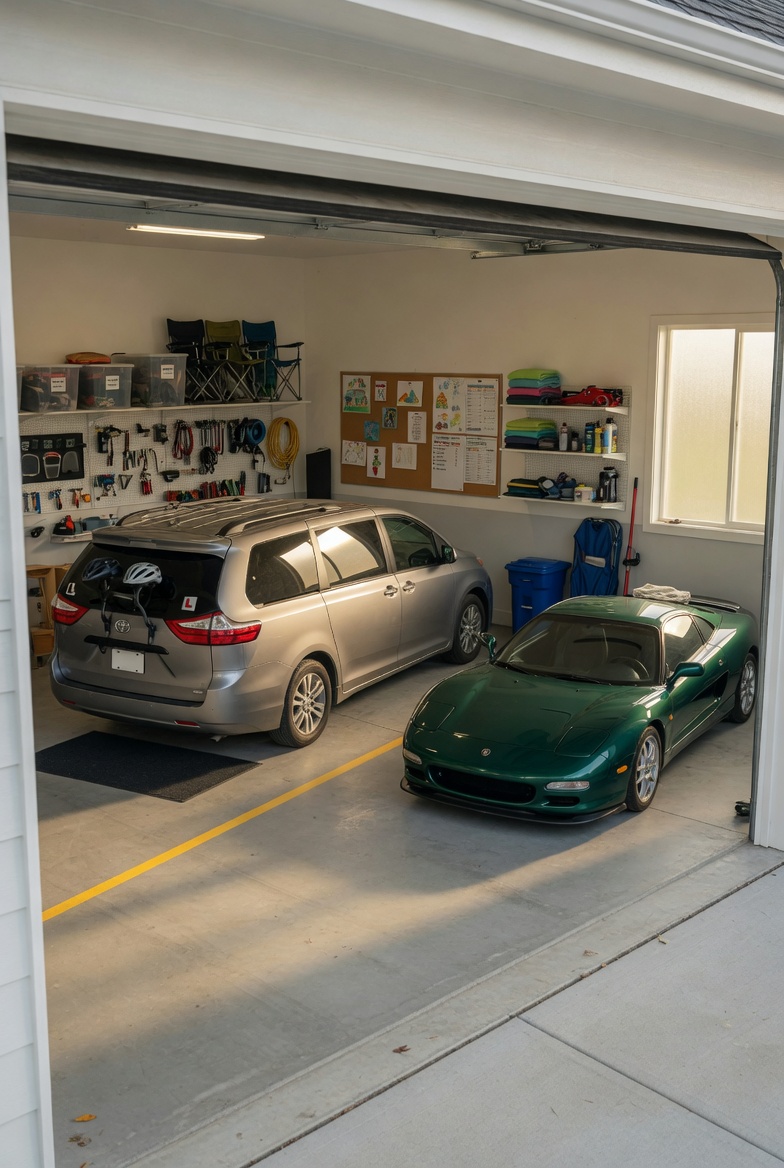
The Two-Garage Solution
Here's what that looks like in practice.
Keep the majority of your capital — the core — where it's structured, disciplined, and producing the yield you need to live on. For many of our clients this sits inside tax-deferred accounts (IRAs, 401(k)s) where income compounds without getting taxed every year. The core is not where you go to feel alive. The core is where you go to stay alive.
Then, if the itch is real, open a separate taxable brokerage account and give yourself a budget. Call it a speculation sleeve. Call it your race car account. Call it fun money. The label doesn't matter. What matters is that it's walled off from the core, sized small enough that it cannot take the rest of the portfolio down with it, and funded with money you can genuinely afford to lose.
Tax treatment aside — and that's a real planning conversation, not a throwaway — this is mostly about concentration risk. That's the risk of putting too much of your money into too few ideas. The rule is simple: don't let a single position, no matter how exciting, become big enough to end the game.
Here's the counterintuitive part: a small opening position in a genuinely great idea doesn't stay small for long. If you're right, it compounds. If you're wrong, the loss is survivable. That's the whole point.
You can have your cake and eat it too. You just have to bake a cupcake on the side.
A Word About the Information You're Acting On
One more thing, because it matters more now than it did twenty years ago.
Markets are forward-looking. History rhymes. You can gather information, form a thesis, and make an informed decision. That's how investing is supposed to work.
But we live in what academics call the "attention economy." Platforms earn money by holding your eyeballs — not by giving you accurate, unbiased information. Section 230 (a federal law that shields online platforms from liability for what users post) means the person shouting "this stock is going to the moon" on social media has no legal obligation to be right, and the platform carrying the message has no obligation to check.
In that environment, the most reliable edge is not being louder or faster. It's sizing your bets so that being wrong is survivable.
Keep the Lights On
If you find yourself watching green charts and hearing buzz about new all-time highs, and you feel like you're missing out, consider this framing.
Think of your custodian profile — the brokerage and retirement accounts that hold your money — as your garage. If the itch is real, go ahead and add a race car account. Give it a defined budget. Let yourself chase the ideas that excite you, on your terms, in a container built for that purpose.
Because here's the thing. If the thrill-seeker gets wrecked — if that race car account suddenly becomes half the size it used to be — you can still keep the lights on. The sensible minivan is safely in the driveway, exactly where you left it, doing the job it was built to do.
Go fast where it's appropriate. Keep it safe where it matters.
And please. Don't screech the tires in the minivan.
Before You Go
You can learn more about our rules-based, automated investment approach — the system we built specifically to keep retirement portfolios from taking the kind of hit that ends the game — at assetguidancegroup.com/ats-mgmt-landing-page-347034.
If this post got you thinking about your own setup — whether your "core" is doing its job, whether a small speculation sleeve would help keep your discipline intact in the big account, or whether your accounts are titled and structured the way they should be — let's talk. Call the office, reach me directly at [email protected], or schedule a review at assetguidancegroup.com/calendar.
───
This post originally appeared on The Lighthouse on Substack — weekly financial analysis written specifically for people within ten years of retirement. Subscribe free at The Lighthouse on Substack or upgrade for weekly Trades of the Week picks.
───
Investing involves risk, including the possible loss of principal. This article is for informational purposes only and does not constitute personalized investment advice. Past performance is not indicative of future results.
Jarod Nichols Investment Advisor Representative Asset Guidance Group, LLC, a registered investment advisor