
The Housing Lock-In and the People Sent to Break It
Why frozen housing matters for retirement — and the fix being teed up.
There's a version of the American story most of us grew up hearing. You finish school. You get a job. You buy a house. You build a family. The kids grow up, leave the house, and someday do the same thing themselves. Equity replaces rent. The cycle continues.
That story is breaking. Not because anyone decided to cancel it — because the math stopped working.
The U.S. housing market has been functionally frozen for three years. Existing-home turnover sits near multi-decade lows. New construction is running below household formation. Nearly half of Americans aged 18 to 29 are now living with their parents — the highest level in modern history. And in late 2025, a study made the rounds in mainstream coverage attributing roughly half of the U.S. fertility decline between the 2000s and 2010s to rising housing costs.
Read that again. Not "housing is one factor in falling birthrates." Half of it. Tracked directly to the cost of putting a roof over a young family's head.
That is not just an economic problem. It's a continuity problem. And it is suddenly the central political and policy story heading into the back half of 2026.

How a Market Freezes
A quick recap, because the mechanics matter.
The 2008 Global Financial Crisis was, at its core, a housing crisis. Too many homes built. Too many loans written. Too many of those loans repackaged and sold and resold on Wall Street, often to people who had no business owning them. The Big Short turned that story into a movie. The policy response turned interest rates into the floor — near zero — for the better part of a decade.
That kept the patient alive. It also set the stage for what came next.
When COVID hit in 2020, two things happened at once. Remote work made where you lived suddenly more important than ever. And the trillions of dollars in stimulus pumped into the economy needed somewhere to go. A lot of it went into houses. Prices went vertical.
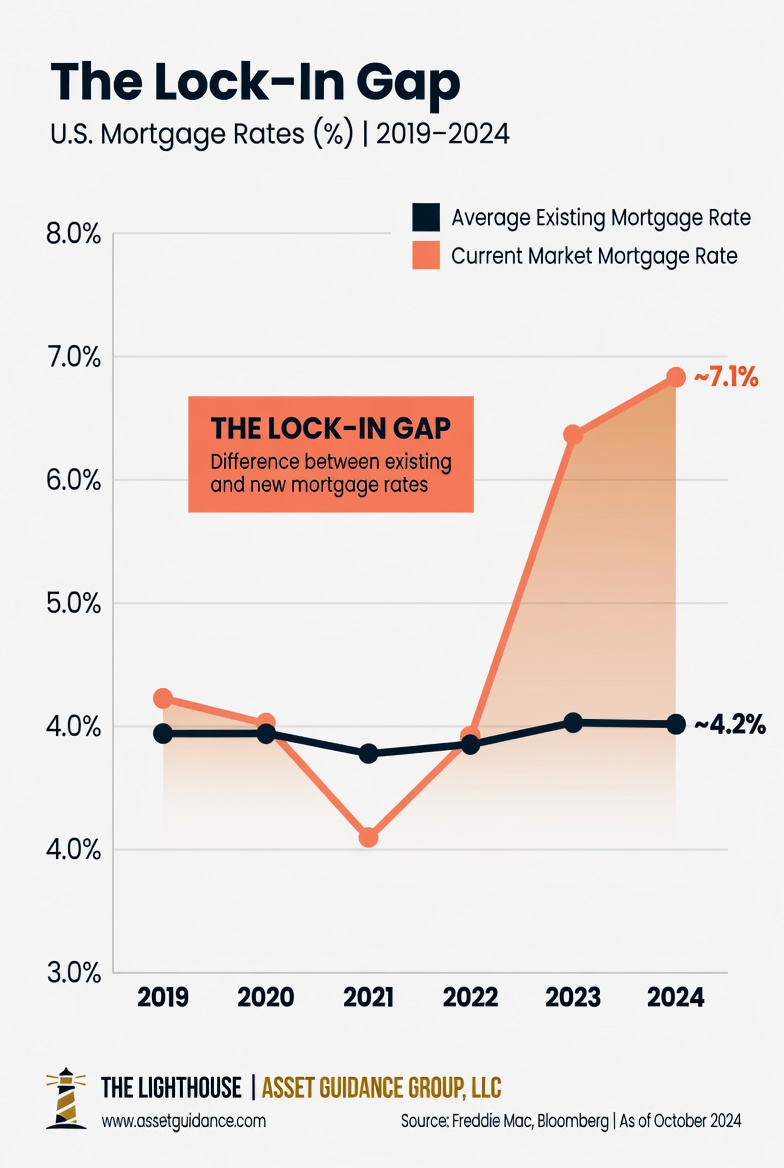
Then inflation arrived — predictably — and the Fed had to slam the rate brakes to fight it. Mortgage rates roughly tripled in eighteen months.
That's the trap we're still in. Anyone who locked in a 3% mortgage in 2020 or 2021 isn't moving — because moving means swapping a 3% payment for a 7% payment on a more expensive house. So inventory dries up. New buyers face high prices and high rates at the same time. Builders, watching demand fall through the floor, slow down. Household formation outpaces housing starts. Young adults move home with mom and dad, indefinitely.
That's a frozen market. And the longer it stays frozen, the more the family-formation math compounds against us.
The Wind-Up and the Pitch
If you accept that the freeze is the problem, the next question is: who has the power to thaw it?
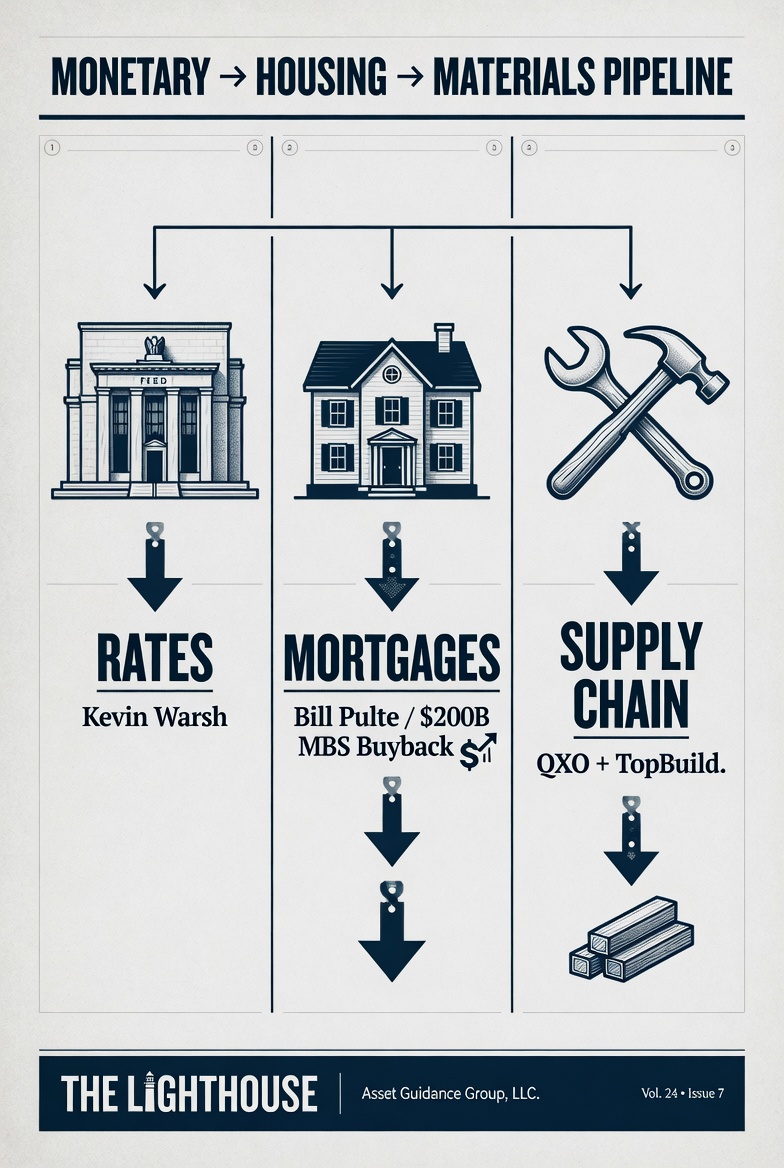
The real answer is: no single person. But three pressure points all matter, and three people are quietly being lined up to push on them. Whether you cheer or curse the players, the setup itself is worth understanding — because the outcome shapes mortgage rates, the bond market, building-materials stocks, and the ability of your kids and grandkids to buy their first home.
Pressure Point One: The Federal Reserve
The Fed sets the overnight rate that anchors everything else, including mortgage pricing. Jay Powell is stepping down from the chairmanship on May 15. Kevin Warsh — former Wall Street investment banker, former Bush 43 economic policy advisor, and a Fed governor during the 2008 crisis — is the nominee to replace him.
Warsh's path through Senate Banking has not been quiet. The committee voted 13-11 along party lines on April 29 to advance him to the floor. Senator Elizabeth Warren has led the opposition, raising concerns about Warsh's independence and his proximity to the White House. At his April 21 confirmation hearing, Warsh was asked directly whether he would simply do what the President wanted. His answer, on the record: "I'm no sock puppet."
Whether that holds is the question Politico framed in an April 29 piece titled, accurately, "Thoughts and prayers: The minefield that awaits Kevin Warsh." Cut rates aggressively and he risks reigniting inflation. Hold the line and he risks open warfare with the administration that put him there. There is no clean exit.
For our purposes, what matters is the directional bias. Warsh has been openly sympathetic to lower rates. If confirmed, the trajectory likely tilts dovish — at least at the margin.
Pressure Point Two: The GSEs
Most mortgages in this country don't sit on a bank's balance sheet. They get packaged into Mortgage-Backed Securities by Fannie Mae and Freddie Mac — the Government-Sponsored Enterprises that make the U.S. mortgage market work. (Again, see The Big Short.)
The GSEs answer to the Federal Housing Finance Agency, or FHFA. The current FHFA director is Bill Pulte — yes, of the Pulte Homes family. He was sworn in March 2025 with bipartisan Senate confirmation. Within weeks he replaced fourteen board members at Fannie and Freddie and effectively consolidated management of the two enterprises under one roof.
In January 2026, at the President's direction, the FHFA announced a $200 billion Mortgage-Backed Securities buyback program — a direct intervention designed to push mortgage rates lower without waiting on the Fed. Whatever you think of the politics, the mechanism is real: every dollar the government spends buying MBS lowers the yield those securities pay, which translates into lower mortgage rates for borrowers.
Pulte's tenure has not been clean. There has been an internal Fannie ethics review of FHFA leadership pressure, public criticism over a now-walked-back proposal for fifty-year mortgages, and concerns about the use of his perch to promote unrelated policy priorities. None of that has slowed the buyback or the consolidation. The direction of travel is clear.
Pressure Point Three: The Builders' Supply Chain
Lower rates and more MBS liquidity don't help if there's nothing to buy. Building costs matter. So does industry consolidation.
Enter QXO, a publicly traded building-products company run by Brad Jacobs — the same operator behind United Rentals and XPO Logistics. In April 2026, QXO announced a roughly $17 billion deal to acquire TopBuild, the largest insulation installer in the country. Jacobs has been blunt about the strategy: "Over the past 11 months, we've built QXO into a market leader through more than $13 billion of acquisitions." The roll-up playbook he ran in equipment rental and trucking is being applied to building materials.
Sitting on the QXO board: Jared Kushner, since 2024. Whatever you make of that, it's a fact in the proxy.
The deal isn't uncontested. At least one shareholder firm has launched a fiduciary-duty investigation into TopBuild's board over whether the company is being sold too cheap. That's the kind of nuance that gets lost in cable-news coverage and is worth knowing if you own the stock or are thinking about it.
The Pushback Worth Taking Seriously
Now for the other side of the argument — because anyone telling you a thesis without a counter-argument isn't being straight with you.
The strongest case against the "lower rates fix housing" view comes from people you'd expect to know.
Jay Powell himself said it bluntly in late 2025: rate cuts will not fix the U.S. housing market because the problems are structural — supply, zoning, construction labor — not just borrowing costs. The Fed, in his words, "doesn't have the tools to solve the housing shortage."
Tom Barkin, the Richmond Fed president, has been blunter still: "The way to bring housing prices down is to build more housing."
A 2025 NBER working paper challenged the standard YIMBY view that local supply elasticity explains price growth, complicating the simple "build more" answer.
And the sharpest one-line rebuttal of all came from the Marginal Revolution blog: "When you lower the interest rate, you raise home prices an equal amount. The monthly payment is the same."
That last one is the argument that should keep everyone honest. If the Fed cuts rates and the FHFA buys MBS, but supply doesn't respond, the most likely outcome is that prices rise to absorb the affordability gain. The buyer's monthly payment doesn't change. The seller and the existing homeowner get richer. The first-time buyer is no better off.
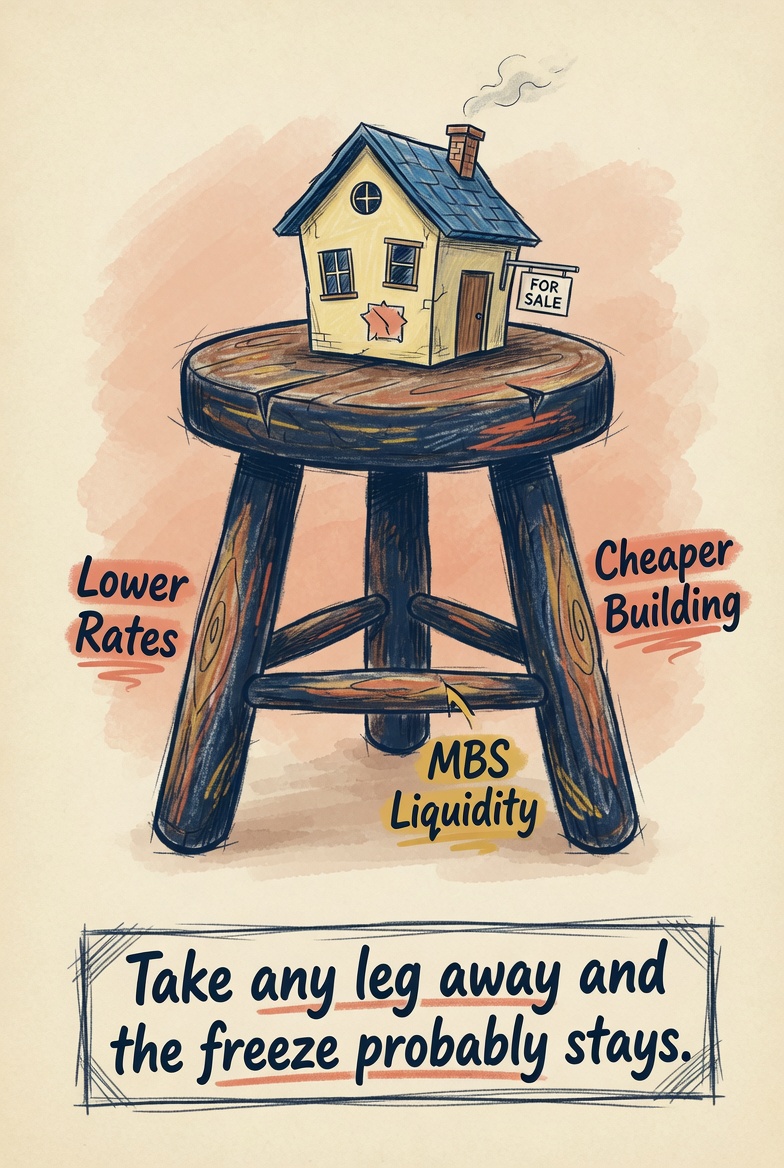
Which is why the QXO/TopBuild story actually matters. If consolidation in building materials lowers the cost of new construction, and rates come down, and the GSEs grease the mortgage market, then you have a real chance of breaking the freeze. Take any one of those legs away and the price-inflation critique probably wins.
What This Means for Your Retirement
If you're within ten years of retirement, the housing question shows up on your plan in at least four places.
Your home equity. For most retirees, the house is the single largest asset on the personal balance sheet. A frozen market caps the realistic market value of your home — and limits your ability to downsize, relocate, or tap equity through a reverse mortgage or a sale-and-rent. A thaw, even a partial one, restores optionality.
The bond market. A $200 billion MBS buyback is, by definition, a large bid for fixed income. That puts downward pressure on yields across the curve, which matters if you hold bond funds — and it changes the calculus on what duration you want to own. The directional bias of rates from here is no longer a one-way street.
Your kids and grandkids. This is the part nobody talks about until it's their kid sleeping in the basement at twenty-eight. The single most important household-formation variable in this country is whether young adults can afford a starter home. If the freeze breaks, the timeline for the next generation reaching financial independence shortens. If it doesn't, family wealth transfers — gifts, education funding, down-payment support — become a much bigger part of retirement planning than most people are budgeting for.
Speculative angles. The GSE story has investment implications. Michael Burry has confirmed sizable FNMA and FMCC positions on a privatization or up-listing thesis. Bill Ackman has called a GSE recap his "best idea for 2026." Brad Jacobs has built QXO into a building-materials roll-up that has rewarded shareholders so far. None of these are recommendations. All of them are real, public, and worth watching — and they belong in the speculative part of a portfolio, not the part funding your living expenses for the next thirty years.
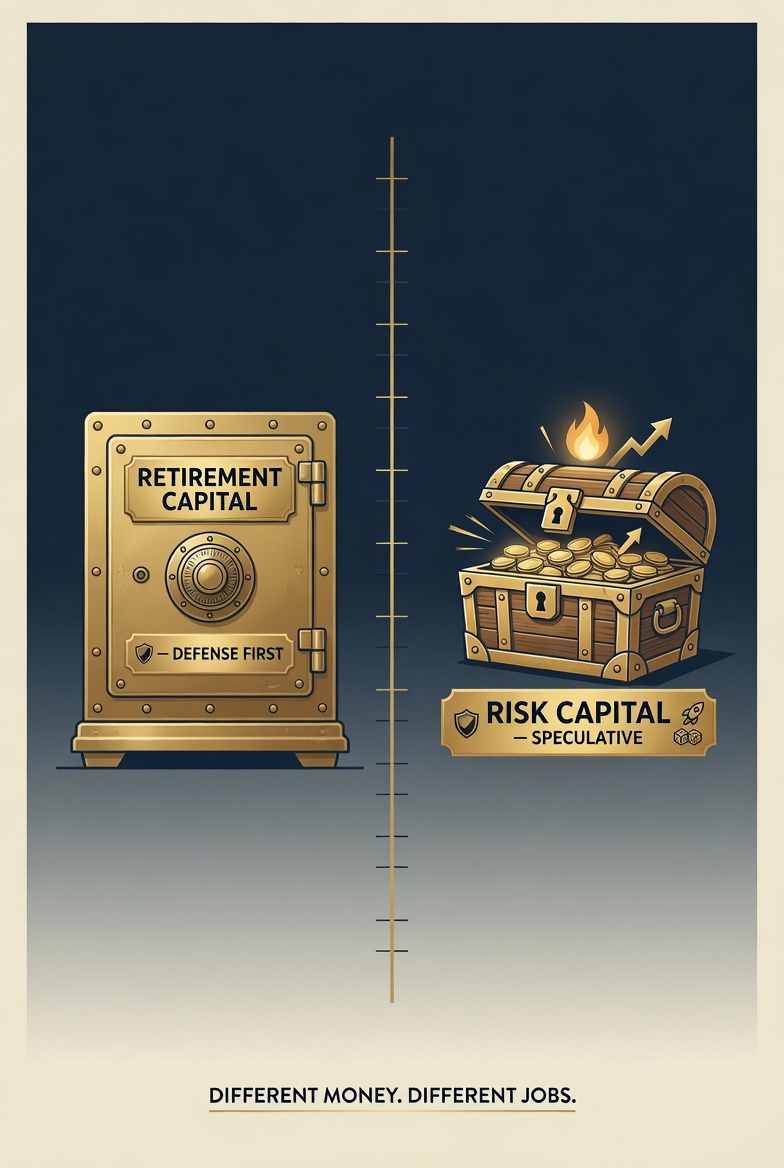
That last distinction matters. Different money has different jobs. The capital that pays your bills in retirement should not be sitting in single-name bets on a privatization timeline. The capital that's true risk capital — money you can afford to lose without changing your life — is where these themes belong. We separate those buckets explicitly at AGG, and we don't blur the line.
What We're Doing About It
Our job at AGG is not to predict whether Warsh gets confirmed, whether the MBS buyback works as designed, or whether QXO finishes the TopBuild deal at the originally announced price. Our job is to position client capital so that whatever happens, the plan still works.
The Automated Trading System we run for retirement money — AGG's rules-based engine — monitors risk signals every thirty minutes throughout every trading day. It does not "set defensive positioning weeks ago" and walk away. It adjusts. Daily. When the bond market repositions around a rate-cut path, the system sees it and responds. When credit spreads widen because investors get nervous about the GSE recap timeline, the system sees that too.
We are not trying to be heroes on macro calls. We are trying to make sure that the math of a 50% loss — which still requires a 100% gain just to get even — never gets a chance to wreck a retirement that took you forty years to build.
That's the job. The frozen market thaws or it doesn't. Warsh delivers or he doesn't. Pulte's buyback works or it gets repriced by the market. We don't have to guess right on any of those to do our job. We have to be ready for any of them.
The lighthouse doesn't move. In a storm, that's the point.
Take Action
If you're reading this in your inbox, the ❤️ heart, the comment box, and the share button are sitting on the Substack site, not in the email. Tap the title or click through — it takes two seconds, a quick like helps The Lighthouse find more readers who need this kind of analysis, and it costs you nothing. While you're there, leave a comment, share the post with anyone who's been venting about housing prices, or subscribe if a friend forwarded this to you.
Visit the ATS landing page if you want to see how we run retirement money: assetguidancegroup.com/ats-mgmt-landing-page-347034
If this article raised questions about your own situation — your home equity, your bond holdings, whether your plan accounts for the next generation needing help — let's talk. Email [email protected], call the office, or schedule a review at assetguidancegroup.com/calendar.
───This post originally appeared on The Lighthouse on Substack — weekly financial analysis written specifically for people within ten years of retirement. Subscribe free at The Lighthouse on Substack or upgrade for weekly Trades of the Week picks.───
Disclosure: As of early May 2026, I personally hold long positions in FNMA and FMCC. I do not currently hold EL, PHM, or QXO, though that may change. Nothing in this article should be taken as a recommendation to buy, sell, or hold any specific security. The investment themes discussed here are speculative and belong in risk capital, not retirement capital. Different money, different jobs.
Investing involves risk, including the possible loss of principal. This article is for informational purposes only and does not constitute personalized investment advice. Past performance is not indicative of future results.
Jarod Nichols Investment Adviser Representative Asset Guidance Group, LLC, a registered investment advisor