Your Bond Balance Is Falling. That Is Two Completely Different Stories.
Why 5.2% on a long bond takes fifteen years to pay off, and how to tell a harmless decline in principal from one that should worry you
Part 2 of a two-part series. Yesterday's article covered the Treasury's buyback expansion and a soft 20-year auction.
Yesterday I wrote about the Treasury's decision to double its buybacks of long-dated bonds, and about the 20-year auction hours later that priced at the second-highest yield ever recorded for that maturity. The short version: the government is leaning against the long end of the bond market, and the long end is not especially impressed.
Today is the part that matters more, because it is the part you can act on.
Two questions have been coming into the office all year. The first is from people looking at long Treasuries paying north of five percent and wondering whether to reach for it. The second is from clients watching income arrive every month while their account balance drifts lower, and wanting to know whether that is normal or whether something is wrong.
They turn out to be the same question wearing different clothes.
The Case for Reaching
The Temptation Sitting in Plain Sight
All of which sets up the question most readers are actually holding right now. Long Treasuries pay more than they have in a generation. The 30-year sits around 5.25%. Treasury sold $16 billion of 20-year bonds this afternoon at 5.204% — the second-highest yield ever recorded at a 20-year auction, behind only October 2023 [U.S. Treasury auction results, 2026-08-19]. For an income investor, that looks like a gift.
In important ways it is one. Money deployed at these levels locks in forward income at rates unavailable for most of the last twenty years, and a Treasury carries no credit risk — the coupon arrives whether or not the price moves. If you buy a bond and hold it to maturity, the market value in between is a quote, not an outcome. You get your coupons and your principal back.
The Break-Even Almost Nobody Mentions
There is a mechanism underneath that most people never have explained to them, and it decides whether buying long here is smart or painful.
When yields rise, two things happen at once and they point in opposite directions. The price of the bond you hold falls immediately. But every coupon you collect from that day forward can be reinvested at the new, higher rate. The first effect is a one-time loss. The second is a small tailwind that compounds for as long as you hold.
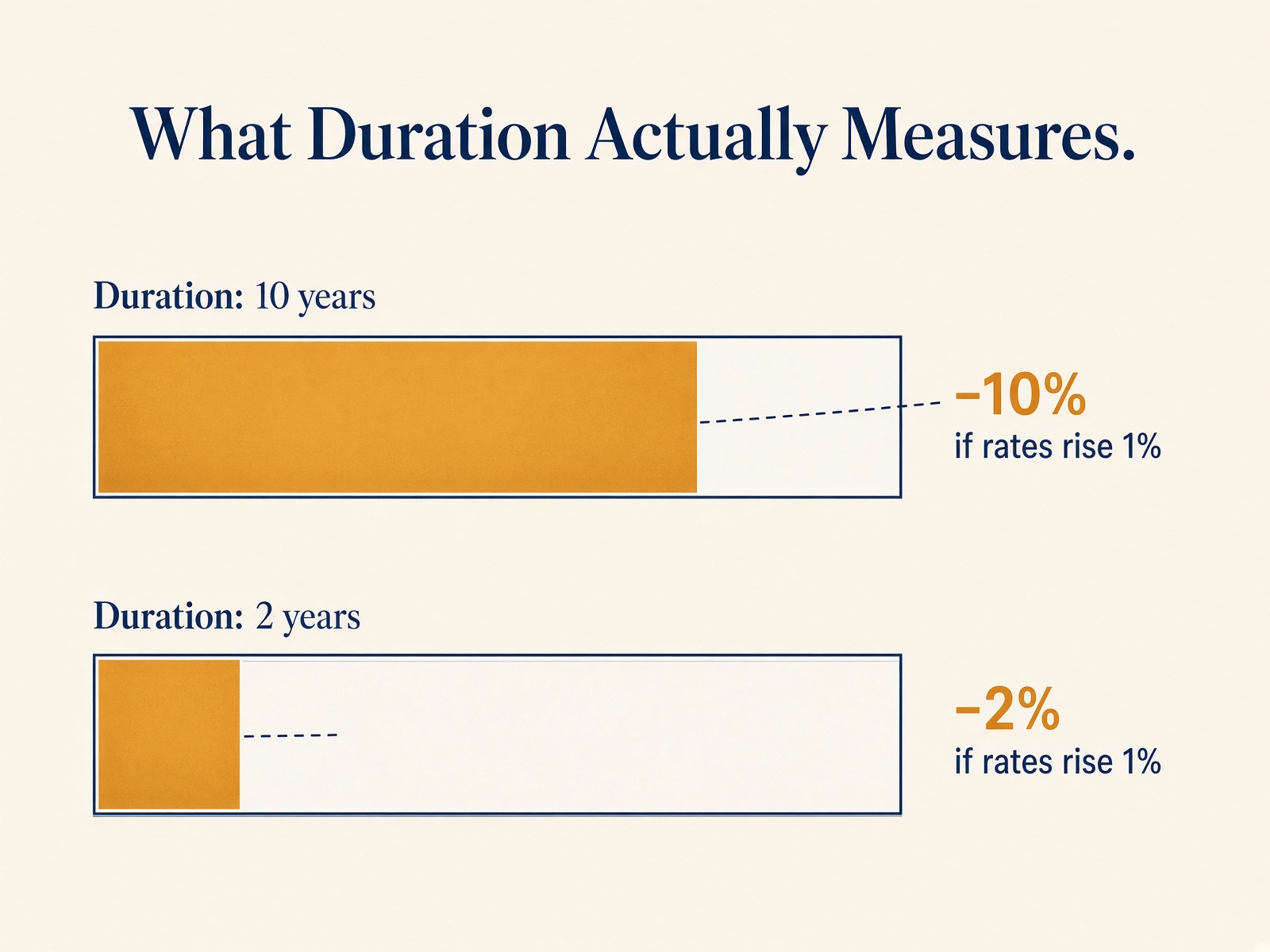
The time it takes for the tailwind to fully offset the loss has a name and a number. It is approximately the bond's duration. Hold longer than that, and a rise in yields makes you better off in total-return terms. Sell sooner, and the price decline wins.
Now put a number on it. For a 30-year Treasury yielding around 5.25%, that break-even horizon runs roughly fifteen years. For today's 20-year, it is close to thirteen.
Read that against the age of the person reading this. If you are 62 and you buy the 30-year today, the math that makes the purchase a good idea finishes working when you are about 77. That is not a reason to avoid it. It is a reason to know what you are agreeing to. This is also why matching the duration of a bond to the date you actually need the money — pension funds call it immunization — neutralizes price risk almost exactly, and why a long-horizon buyer with no need to sell should treat a selloff as a better entry point rather than a warning.
Three Ways That Argument Breaks
The hold-to-maturity case is sound, and it fails in three specific situations that a pre-retiree should check before leaning on it.
The first is a forced sale. If a liquidity need arrives before the horizon — a roof, a diagnosis, a year when the market is down and the portfolio has to produce income anyway — the paper loss becomes a realized one. Permanently.
The second is leverage or margin. An unrealized loss can trigger real constraints in an account subject to margin marks, even when you had no intention of selling.
The third is inflation, and it is the one most relevant to this particular moment. The break-even math above protects your nominal income. It does nothing for what that income buys. With oil-linked pressure still in the system, a nominal Treasury locks in a dollar amount, not a standard of living. Inflation-protected Treasuries are built for that problem and conventional ones are not — which is why anyone reaching for 5.25% should look at where inflation expectations have moved alongside those nominal yields, not just at the headline coupon.
The Money Already Invested
Why Our Fixed Income Has Been Held Short Duration
Now turn the same lens on money that is already invested.
We have deliberately kept the fixed-income side of our managed portfolios short — in the neighborhood of two years [AGG internal positioning record, 2026-08]. Using the same duration arithmetic from above, that means a one-percent rise in rates costs roughly two percent of value, not fifteen. It is the reason this year's long-bond selloff has not landed on our clients' bond allocations the way it has landed on portfolios built around long-dated Treasuries. While the 30-year yield pushed past 5.30%, the 2-year sat near 4.17% and barely moved [Federal Reserve H.15, 2026-08-17].
Staying short has not meant accepting less income, and I want to correct an assumption most readers bring to this. Because the income in that sleeve comes from lending to credit rather than from lending long, its yield has been running above what the 30-year Treasury pays, not below [AGG internal positioning record, 2026-07; Federal Reserve H.15, 2026-08-17]. We took the risk that borrowers run into trouble instead of the risk that rates rise.
That is a trade, not a free lunch. If the Fed eventually cuts, short-maturity holdings mature into a world of lower yields, and that reinvestment cost is real. Credit risk is a different animal from rate risk, not a smaller one. Positioning short narrows exposure to interest-rate risk; it does not eliminate risk — no positioning does — and we take every measure practicable.
The Question Is Not How Long — It Is Why
Here is where I want to part company with the framework I just laid out, because applied to the wrong portfolio it produces false comfort.
The hold-to-maturity argument depends on two features a credit portfolio does not have. A bond fund does not mature — there is no date on which it hands your principal back, so there is no price to wait out. And a corporate borrower, unlike the Treasury, can default. When principal is permanently impaired by a default, no reinvestment timeline brings it back. Waiting is not a strategy there; it is just waiting.
So for the income side of a portfolio, the question "my principal is falling, is that acceptable" is not answered by arithmetic at all. It is answered by diagnosis. Why is it falling?
That single question sorts a falling balance into two categories that look identical on a statement and could not be more different underneath.
When Falling Principal Is Just Arithmetic
The first category is mechanical, and it is where most of this year's discomfort actually lives.
When a bond fund pays out income monthly, the payment comes out of the fund's own value, and the price you see quoted is the price after the money has left. A holding paying seven percent a year in cash will show a price line that looks flat to slightly falling even in a year when the investment did fine. The cash did not disappear. It changed location — out of the balance, into your distribution.
The public numbers show the shape. The S&P U.S. Dollar Global High Yield Corporate Bond Index returned about 2.4% on a total-return basis through the first half of 2026 [S&P Dow Jones Indices, as of 2026-06-30]. Across that same half-year, high-yield credit paid out roughly three and a half percent in income. Subtract the income from the total and what remains is the price line — down about a point. Positive total return, negative price line, same six months.
If you read your balance and your distributions as two separate stories, you will count a dollar as a loss in one column that you already collected in the other. The difference between price return and total return is the most useful thing an income investor can learn, and almost nobody gets taught it.
The second mechanical case is the one filling the headlines this week. The move in Treasuries has been a long-end rate event — the 20-year and 30-year — and our income holdings carry very little long-end interest-rate exposure by design. The selloff you have been reading about is, for that part of the portfolio, largely somebody else's weather. That is not luck. It is what the short positioning was for.
When Falling Principal Is a Warning
The second category is the one that matters, and it is why none of the above should read as an all-clear.
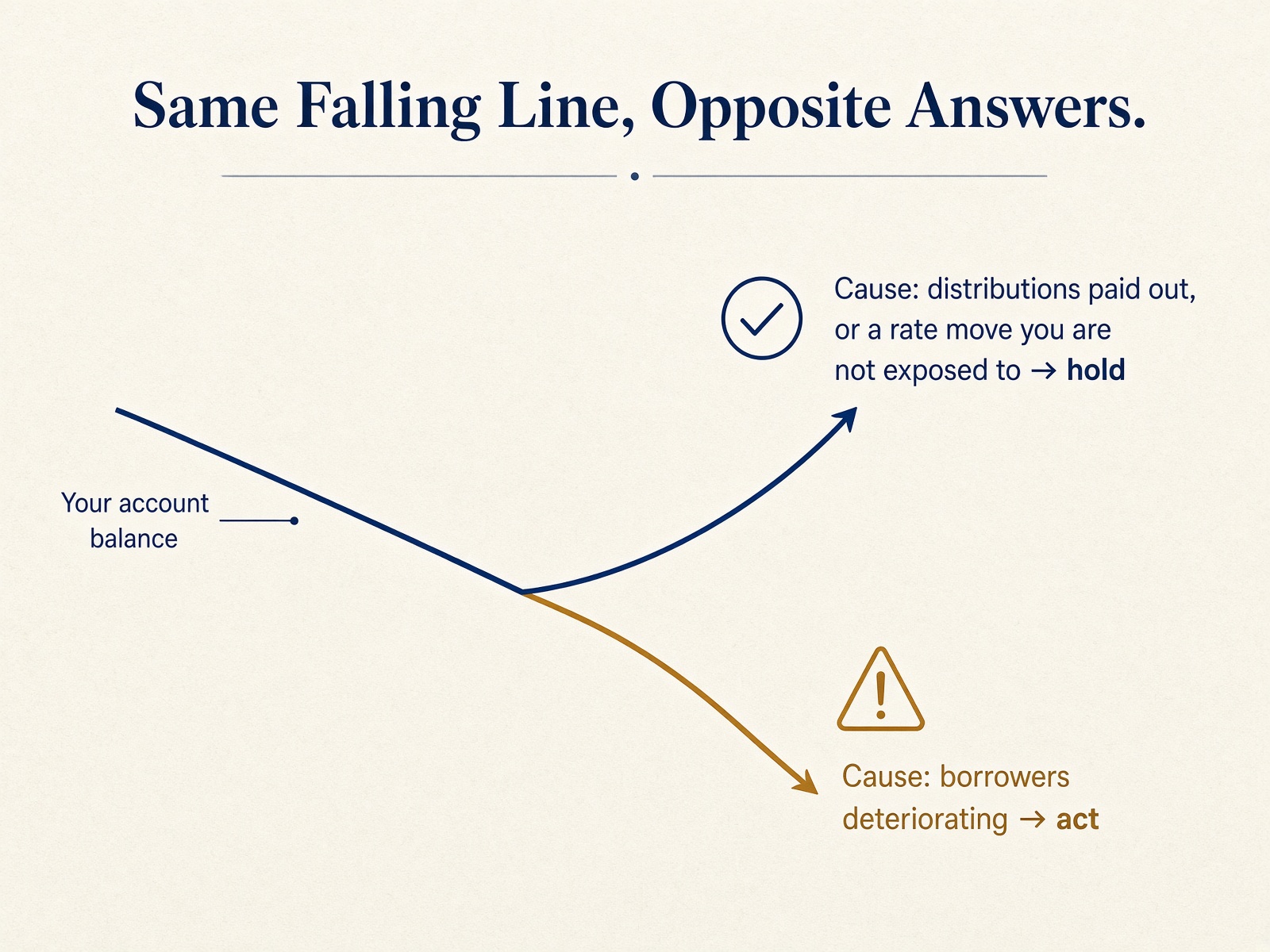
If principal were falling because borrowers were genuinely deteriorating — defaults rising, the market demanding materially more compensation to hold corporate debt — that would be real impairment, not an accounting artifact, and no amount of monthly income would offset it. There would be nothing to wait for. The correct response is to reduce exposure before the impairment becomes permanent.
So: a decline driven by distributions, or by a rate move you are not exposed to, is a condition to hold through. A decline driven by credit deterioration is a condition to act on. Same falling number on the statement, opposite correct answers — and the entire job is telling them apart early enough for the answer to matter.
This week's move is squarely in the first category. The extra yield investors demand to hold high-yield debt over Treasuries sat at about 2.71 percentage points in mid-August, essentially unchanged from a year earlier [ICE BofA US High Yield Index Option-Adjusted Spread via FRED, 2026-08-13]. Rates moved. Credit did not.
But notice what that number also says. It sits near the tight end of its long history, against a long-run typical level closer to four and a half percentage points. Tight spreads mean investors are paid comparatively little for taking credit risk, which leaves a thin cushion if conditions turn. Calm is not the same as safe — and the two risks do not even announce themselves the same way. Rate risk telegraphs itself for months in the yield curve. Credit risk sits quiet and then moves quickly. That asymmetry is exactly why the response has to be built in advance, while the weather is fair.
What We Are Doing About It
What Careful Change Looks Like
Over this summer we completed a full review of how the fixed-income side of our management handles credit conditions. That review produced a set of changes designed to reduce credit exposure in stages as credit conditions deteriorate — stepping down as the weather turns, rather than waiting for a stock-market panic to be the first thing that triggers a response.
Here is the part I want clients to hear, because it is the part that describes how we work. Those changes are not live. They are documented, they have been tested against long historical periods, and they are currently running alongside the real portfolios in observation mode — recording what they would have done, without touching a dollar — with a review date on the calendar before anything is deployed [AGG internal implementation record, 2026-08].
That sequence is the point. Study it, write it down, test it, watch it work in the open, review it on a schedule, then deploy. Not the other way around. Staging a change this way reduces the chance of an implementation mistake; it does not reduce the chance that markets do something nobody anticipated, and no process ever will.
The Detail That Gets Lost in Most Firms
One more piece, because it is the kind of thing that only shows up when investment management and tax work live under the same roof. In taxable accounts, selling a position at a loss and buying it back within thirty days triggers the IRS wash-sale rule, which disallows the loss. It is a well-known rule and a routinely missed one, because the person managing the portfolio often is not the person thinking about the tax return. We manage taxable sales with that rule in view. Retirement accounts are not subject to it, which is itself a reason the same market event should be handled differently depending on which account it happens in.
That is what a CFP®, an MBA, and a JD in one office is actually for. Not credentials on a wall — the ability to see the investment decision, the tax consequence, and the legal structure at the same time, in the same conversation.
Different Money, Different Jobs
One frame keeps proving itself, and this month is a good illustration.
Different money has different jobs.
Retirement money has one job — to be there when you need it. That is the money where duration discipline, credit awareness, and recovery math matter more than reaching for the last percent of yield. It is managed through AGG's Automated Trading System, the proprietary engine that powers our Automated Discretionary Management service.
Risk capital has a different job. It can take swings and sit through drawdowns. For clients who want AGG-managed exposure to higher-risk, higher-return strategies with capital they can afford to put at risk, we run GrowthVector, our speculative-account offering. For active traders who make their own decisions but want institutional-grade signal work informing them, we publish PulseSignal Weekly — a paid subscription delivering weekly picks with anticipated direction and price targets. It is an aggressive product. It carries meaningfully higher risk than the ATS approach, and it is not appropriate for money you are going to need in retirement.
An environment like this one is exactly where the two jobs get confused. Long bonds are finally paying north of five percent, and the temptation to reach out the curve for that yield is strong. That may prove to be a fine trade. It is not, by itself, a retirement plan.
The Treasury's buyback expansion is a real move and a modest one. It will make the long end of the bond market function better. It will not make a $2 trillion deficit smaller, it will not stop the AI borrowing wave from competing for the same lenders, and nothing in yesterday's auction suggests the long end has finished repricing.
What a retirement account needs in a stretch like this is not a forecast. It is a design that knows which risks it is carrying, can tell you why a number on your statement is moving, and changes deliberately when the evidence says it should.

Take Action
If this arrived in your inbox, the ❤️ heart button and the comment box are not in the email — they are on the Substack version of the post. Click through and they show up. It costs you two seconds and it is genuinely how The Lighthouse finds new readers. Subscribe if you have not, leave a comment with the question this raised, or share it with someone who has been staring at a falling balance and assuming the worst.
If you missed it, Part 1 covered the buyback expansion, yesterday's 20-year auction, and why AI borrowing is competing for the same lenders as the U.S. Treasury.
If this raised a question about your own situation, that is a conversation worth having. Reply to this email, call the office, or schedule a review here. You can also see how our defense-first investment system works at assetguidancegroup.com/ats-mgmt-landing-page-347034. For direct contact: [email protected].
───This post originally appeared on The Lighthouse on Substack — weekly financial analysis written specifically for people within ten years of retirement. Subscribe free at The Lighthouse on Substack or upgrade for weekly Trades of the Week picks.───
Investing involves risk, including the possible loss of principal. This article is for informational purposes only and does not constitute personalized investment advice. Past performance is not indicative of future results. Fixed income investments are subject to interest rate, credit, inflation, and liquidity risks. Equity investments are subject to market risk and may decline in value, sometimes significantly, over short or extended periods.