
This Is That Moment

Every morning this week looked like a bottom. Every afternoon proved it wasn’t. Here’s why — and what it means for your retirement.
Last Sunday, I published an article called “When Everything Moves at Once.”
The thesis was simple and uncomfortable. We are living through a rare market environment — one where the traditional safe havens stop working. Bonds and stocks falling together. Treasuries offering no shelter. The correlations that retirement portfolios were built around quietly breaking down.
I want to take credit for that call. Not to congratulate myself — but because evidence of an analytical framework working in real time is exactly what you should demand from whoever is managing your retirement.
This week was that evidence.
What Happened This Week — The Pattern Nobody Is Explaining
You don’t need me to recap the Iran war. You’ve seen the headlines.
What you may not have fully processed is what happened in the markets every single day this week. And more importantly, why.
The week opened with what looked like a turning point. Monday, March 9th — markets rallied. The S&P 500 up nearly 1%. The Russell 2000 up over 1%. Oil pulling back from its highs on talk of coordinated reserve releases. President Trump suggesting possible compromise. For one day, it felt like the worst might be priced in. Like the floor had been found.
It hadn't.
Oil re-ignited Tuesday night, surging more than 4% after regular trading closed. Wednesday was directionless — the market couldn't find conviction either way. Thursday was the break. The S&P fell 1.52%. The Dow shed 739 points. The Nasdaq dropped 1.78%. All three major indexes set fresh closing lows for 2026.
Friday's pre-market futures pointed higher. It looked like a bounce. Stocks fell again anyway.
By the close on Friday, the S&P 500 had posted its first three-week losing streak in about a year. The Monday rally — the one that felt like relief — had been completely erased and then some. It was a mirage.
Here's why.
The Asymmetry Problem Markets Can't Solve
There is a fact sitting at the center of this week's market behavior that your financial media is not explaining clearly enough.
The United States has the most powerful military in the history of human civilization. Undisputed command of the airspace above Iran. The most technologically advanced naval force ever assembled. More defense spending than the next ten nations combined.
And Iran's inexpensive drone technology is keeping the Strait of Hormuz effectively closed to commercial shipping.
Let that sit for a moment.
This is not a failure of American military capability. It is a problem of asymmetric cost structure — and markets are pricing it precisely. A drone that costs a few thousand dollars can appear from any shoreline at any moment. No insurance company on earth will underwrite a tanker transiting a waterway where that is true at commercially viable rates. The Strait doesn't need to be physically blocked. It just needs to be practically impassable.
It is.
Markets are not making a judgment about the American military. They are making a judgment about resolution timeline. And the math of asymmetric warfare tells them that timeline is unknowable. Cheap drone technology means the disruption can persist for months even if every known launch site is destroyed, because concealed launches can continue indefinitely as long as hostilities exist.
This is why every rally attempt collapsed. Investors cannot model when this ends. And investors who cannot model when something ends do not hold rallies. They sell them.
The Credibility Gap That Made It Worse

Here is where the week went from difficult to disorienting.
When the administration's messaging characterizes Iranian leadership as cornered and hiding — and open-source video circulates of those same leaders walking streets while citizens protest the ongoing bombardment — markets are watching two contradictory signals simultaneously.
On Thursday, U.S. Energy Secretary Chris Wright told CNBC directly that the Navy is "not ready" to escort oil tankers through the Strait of Hormuz. "We're simply not ready," he said. "All of our military assets right now are focused on destroying Iran's offensive capabilities."
Also on Thursday, Iran's newly appointed supreme leader, Mojtaba Khamenei, declared publicly that the Strait of Hormuz should remain closed as — I'm quoting directly — "a tool to pressure the enemy."
That same day, all three major indexes hit their lowest closing levels of 2026.
Markets don't just price events. They price the reliability of the information they're being given about events. When official statements and observable reality diverge visibly, investors cannot build a credible resolution timeline. Without a resolution timeline, there is no durable floor. Every bounce gets sold.
That's the mechanism behind this week. Not panic. Rational behavior in the face of an unresolvable variable.
The Safe Haven Problem
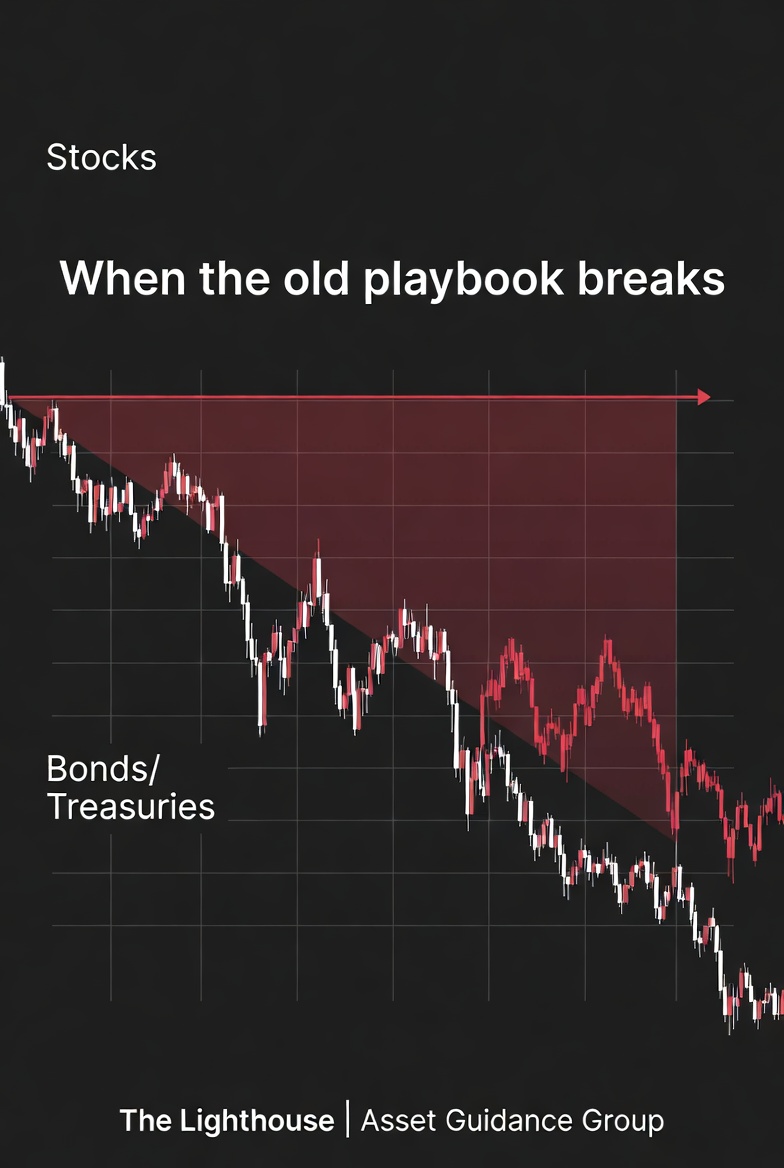
Normally, when stocks fall, investors rotate into bonds and treasuries. Prices go up, yields come down. That relationship has anchored portfolio construction for decades. It's why the classic diversified portfolio was supposed to protect you during downturns.
This week, that relationship frayed — again.
While equities were punished broadly — with a few energy-adjacent names catching a short-term war premium bid — the so-called safe havens failed to hold. Bond and treasury markets flirted with stability, sold off, steadied, and closed the week weaker than they started. Yields crept higher through much of the week, which means bond prices fell. Simultaneously.
When stocks and bonds fall together, there is nowhere for a traditionally diversified portfolio to hide.
Last Sunday's article called this by name. This week demonstrated it in real time, in live market data, across every session.
That is not a coincidence. It is the environment I have been preparing your portfolio for.
This Is What Prepared Looks Like
Let me be direct about something, because I think you deserve a straight answer rather than reassuring language.
If you're watching energy stocks run and looking at your retirement account and wondering why they look different — that question is worth addressing honestly.
Defensive positioning during a war-driven oil shock, a deteriorating jobs market, and a stagflationary macro environment will not keep pace with a concentrated bet on crude that happened to be on the right side of a geopolitical binary event. That's true. I'm not going to pretend otherwise.
But here's what defensive positioning is doing:
It is protecting the base. It is keeping the arithmetic from becoming catastrophic. It is making sure that when clarity eventually returns — when the Strait reopens, when the Fed signals its next move, when the resolution timeline becomes modelable — your retirement portfolio is positioned to participate in the recovery rather than spending years trying to climb out of a hole.
A 50% loss requires a 100% gain just to break even.
That is not a slogan. It is the arithmetic that governs every decision I make. And it is why the math of loss is more unforgiving the closer you are to retirement — not less.
The Question You Might Be Asking

I want to address something directly, because I suspect some of you are thinking it even if you haven't said it out loud.
Some of you manage a smaller personal brokerage or trading account alongside the IRA I manage for you. Some of you are day-trading those accounts and seeing gains in energy positions right now. And you may be wondering: why isn't my retirement account doing the same thing?
That comparison sounds logical. It isn't. Here's why — and I'll be direct, because vague reassurances don't serve you.
The stakes are categorically different. Your trading account can go to zero and your retirement plan survives. Your IRA is your retirement plan. I am legally bound — as your fiduciary — to treat those two pools of capital with fundamentally different risk tolerances. The constraint isn't timidity. The constraint is the job.
The measurement window is being cherry-picked — usually unintentionally. Starting the clock at the open on March 2nd, the first trading day of the Iran conflict, and comparing a long-energy day-trade to a diversified defensive IRA measures one thing: who happened to be long oil when the bombs dropped. What happened in the trading account the week before? What happens the morning a ceasefire is announced and crude gaps down 20% at the open? I have a fiduciary obligation to report results accurately and completely — to regulators and to you. The trading account answers to no one but the mirror.
The current energy bid is a war premium, not a skill set. Anyone long crude on February 27th is printing money right now. That's position timing in a binary geopolitical event — not analysis, not a system, not a repeatable edge. The question isn't whether energy is up during an oil war. It's what happens to a concentrated energy bet when the war ends. The historical answer to that question is not kind.
The scope of what I'm managing is incomparable. Your IRA is simultaneously exposed to equity risk, interest rate risk, inflation risk, currency risk, credit risk, and longevity risk. Managing that portfolio defensively in a stagflationary war environment is a fundamentally different exercise from a directional bet on a single commodity. These two activities do not share a unit of comparison.
You are in the fragile decade. A great quarter in your retirement account is helpful. A catastrophic quarter at the wrong moment is actuarially unrecoverable. I am not optimizing for this quarter. I am optimizing for the next twenty-five years of your life. Those are different problems with different solutions — and they require different standards of care.
If your trading account is outperforming your IRA right now, good. I mean that sincerely. But when you compare those two numbers, you are not comparing two versions of the same thing. You are comparing a sprint to a marathon and asking why the marathon runner isn't moving faster.
What We're Doing About It
Our system moved to defensive positioning at the open on Monday, March 2nd — the first trading day of the Iran conflict. That was not a prediction. It was an automated response to real-time risk signals that the system is built to detect and act on, without emotion, without hesitation, and without the behavioral biases that cause most investors to hold too long and sell too late.
I want to be clear: defensive does not mean static. The system monitors risk signals continuously throughout every trading day and adjusts positioning as conditions evolve. We are not sitting on the sidelines watching. We are managing — every session, with tested discipline, within a framework built specifically for the kind of correlated, multi-asset stress that this week delivered in abundance.
I am also in the process of refining the fixed income component of the system. In a stagflationary environment — rising energy prices, weakening jobs data, a Fed that cannot cut without worsening inflation — spreading fixed income exposure evenly across the duration spectrum is not optimal. Historical precedent and current backtesting both support a stronger weighting toward the shorter end of the yield curve. That work is ongoing. This is what active, engaged management looks like: not reacting to headlines, but continuously stress-testing the system against evolving data and refining where the evidence points.
This Wednesday, March 18th, the Federal Reserve announces its rate decision at 2:00 PM ET. Fed Chair Powell speaks at 2:30 PM. With oil above $100, February payrolls showing 92,000 jobs lost, and core inflation still running above target, the Fed is navigating a trap with no clean exit. The dot plot update — the Fed's own projection of where rates are heading — will tell us whether policymakers are more afraid of inflation or recession. Either answer carries significant implications for your portfolio.
I will be watching that press conference in real time. A follow-up piece will follow shortly after.
The canary is still singing. We're still listening.
Take Action
If you're reading this in your inbox — and most of you are — the ❤️ heart button, the comment section, and the share options are only visible over on the Substack site. It takes ten seconds to click through and it matters more than you might think. Every like and every share puts this analysis in front of someone else who may need to hear it right now. If this article made you think of someone in the fragile decade who has been watching their accounts this week and wondering what's happening — send it to them. That's the whole point of The Lighthouse.
You can also subscribe if someone forwarded this to you, leave a comment with what you're seeing and thinking, or share this post directly with your network.
If anything here raised questions about your own situation — whether your portfolio is built for this environment, whether your plan accounts for a world where everything moves at once — let's have that conversation. Reply to this email, or schedule a review here. That's what we built this practice to do.
Learn more about the rules-based system managing your portfolio through this environment: assetguidancegroup.com/ats-mgmt-landing-page-347034
Contact: [email protected] | assetguidancegroup.com/calendar
Investing involves risk, including the possible loss of principal. This article is for informational purposes only and does not constitute personalized investment advice. Past performance is not indicative of future results.
Wallace R Nichols, MBA, JD, CFP Chief Investment Officer Asset Guidance Group, LLC, a registered investment advisor
This post originally appeared onThe Lighthouse on Substack. Subscribe for free to get new posts delivered to your inbox.