The Canary is Fine. Here's Why
“[On February 22, 2026], a research outfit called Citrini Research published a fictional memo from the future — set in June 2028 — describing how artificial intelligence triggered an economic catastrophe. The S&P 500 down 38%. Unemployment over 10%. Prime mortgage borrowers defaulting. The whole thing.
It's well-written. It's provocative. It went viral for a reason. And I think its central thesis is wrong.
Not mildly wrong. Fundamentally wrong.” - Wallace R Nichols, MBA, JD, CFP
The Canary Is Fine. Here's Why.
Originally published: February 23, 2026
Author: Wallace R. Nichols, MBA, JD, CFP®
SEO Description: A viral research piece imagines AI destroying the economy by 2028. It's a great read — and it's almost certainly wrong. Here's the case for the other side.
---
Yesterday, a research outfit called Citrini Research published a fictional memo from the future — set in June 2028 — describing how artificial intelligence triggered an economic catastrophe. The S&P 500 down 38%. Unemployment over 10%. Prime mortgage borrowers defaulting. The whole thing.
It's well-written. It's provocative. It went viral for a reason. And I think its central thesis is wrong.
Not mildly wrong. Fundamentally wrong — in the same way that every "this technology will destroy civilization" argument has been wrong for the last two hundred years. Not because the authors are careless. They're not. But because the scenario commits a specific intellectual error that's worth understanding, especially if you're making financial decisions with your future on the line.
The error: Citrini models the disruption in high resolution and the adaptation at zero resolution. They trace every link in the chain of destruction with precision — layoffs to spending to mortgages to credit markets to government revenue. But the humans and institutions in their scenario just... sit there. They don't adapt. They don't innovate. They don't build new things. They don't respond to price signals. They just absorb the blow and spiral downward.
That's not how economies work. It's not how people work. And it's not how this is going to play out.
The "This Time It's Different" Batting Average
Let me start with the historical record, because it's not ambiguous.
Every major technological revolution has produced the same prediction: this will destroy more jobs than it creates, and the displaced workers will have nowhere to go.
Mechanized looms were going to end textile employment. The assembly line was going to create mass unemployment. ATMs were going to eliminate bank tellers. (Teller employment rose for twenty years after ATMs appeared — because cheaper branches meant more branches.) Spreadsheet software was going to wipe out accounting. The internet was going to destroy retail, travel agencies, publishing, and the music industry. It did disrupt all of those. It also created industries that employ tens of millions of people in jobs that didn't exist before.
Citrini acknowledges this history and argues it doesn't apply because AI is different — it improves at the very tasks humans would retrain for. This is the strongest version of the doomsday argument, and it sounds convincing until you notice: every previous generation said the same thing about their disruption. The argument that "this time it's really, truly different" has a two-century batting average of exactly zero.
That doesn't mean AI changes nothing. It changes everything. But "changes everything" and "destroys everything" are very different claims, and only one of them has historical support.
What the Doom Loop Gets Wrong
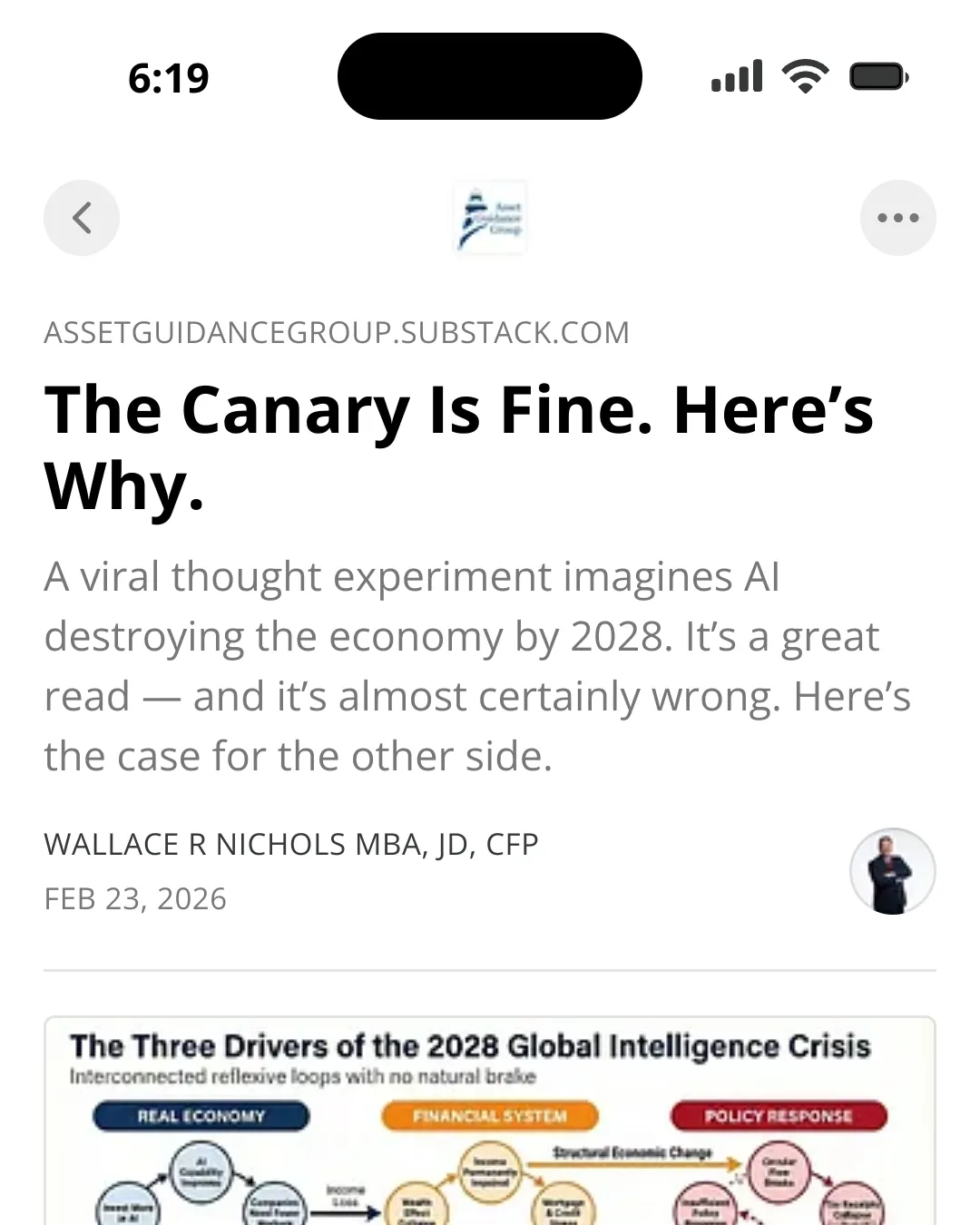
The heart of Citrini's scenario is a feedback loop: AI improves, companies cut workers, displaced workers spend less, companies invest more in AI, repeat. No natural brake.
Here's what's missing from that loop.
Prices fall. When AI makes production cheaper, the cost of goods and services drops. That's not a side effect — it's the whole point. If AI can do the work of a $180,000 product manager for $200 a month (Citrini's own example), then the products that person helped build get radically cheaper. Every consumer's purchasing power goes up. Your dollar buys more housing, more healthcare, more food, more education, more everything. That's the deflationary benefit of productivity growth, and it's the most powerful force in economics. Citrini traces the income side of the equation in detail and barely acknowledges the price side. That's like analyzing a seesaw by only looking at one end.
Entrepreneurs multiply. AI doesn't just help big companies cut costs. It demolishes the barriers to starting a business. Right now, today, a solo founder with AI tools can build software, handle legal documents, manage accounting, create marketing, and serve customers at a level that five years ago required a team of twenty. Citrini's scenario imagines displaced workers drifting into gig economy purgatory. The likelier path for many of them is that they start businesses — because the tools to do so have never been cheaper or more accessible. The cost of launching a company is collapsing toward zero. That's not a crisis. That's an explosion of entrepreneurship waiting to happen.
New demand appears. This is the part that's hardest to see in advance, which is exactly why doomsday scenarios always miss it. When manufacturing automation made goods cheaper, we didn't just buy the same stuff at lower prices. Entirely new product categories emerged — categories nobody predicted. The automobile didn't just replace the horse. It created suburbs, highways, gas stations, motels, fast food, commuter culture, and a half-dozen new industries. The internet didn't just replace the phone book. It created social media, streaming, e-commerce, cloud computing, and the gig economy itself. AI will do the same. The new industries it enables don't exist yet, which means they're invisible to any model that only looks at what's being disrupted. Citrini's scenario accounts for everything AI destroys. It accounts for almost nothing AI creates or will create.
People adapt. Citrini writes about a senior product manager at Salesforce who loses her job and becomes an Uber driver. It's a compelling anecdote. It's also a snapshot, not a trajectory. Humans don't stay in transitional roles permanently. They retrain. They find niches. They combine old skills with new tools in ways nobody predicted. The typesetter didn't stay unemployed — she became a graphic designer. The travel agent didn't vanish — she became a luxury travel consultant, specializing in experiences no algorithm can assemble. The financial advisor who once spent 40 hours a week on portfolio construction now spends those hours on the relationship, the life plan, the conversation that no machine can have. Human adaptability isn't a feel-good abstraction. It's the most documented force in economic history.
Where Citrini Gets It Right
Let me be fair. Citrini isn't wrong about everything.
AI is displacing white-collar jobs. That's real, and it's accelerating. The transition will be painful for people caught in the middle of it. The SaaS repricing they describe is already happening. Some of the intermediation disruption — travel booking, insurance renewals, routine legal work — is clearly visible.
And the private credit concerns are legitimate. PE-backed software deals underwritten at peak valuations on the assumption of permanent ARR growth are going to get repriced. Some of them already are.
But there's a canyon between "some sectors get repriced and some workers have a painful transition" and "the entire economy enters a death spiral with no recovery." The first is a normal feature of technological progress. The second requires you to believe that every single adaptation mechanism in a $28 trillion economy simultaneously fails. That government does nothing effective. That entrepreneurs don't start new businesses. That falling prices don't expand purchasing power. That no new industries emerge. That 160 million workers just collectively give up.
I spent years as a litigator. You learn to stress-test arguments by looking for the assumptions that have to all be true simultaneously for the conclusion to hold. The more assumptions you stack, the more fragile the argument becomes. Citrini's scenario requires at least a half-dozen heroic assumptions to all break the wrong way, at the same time, with no countervailing response. That's not analysis. It's a horror movie script with a footnote.
What I Actually Believe
Here's the case I think the evidence supports.
AI is going to be the most significant productivity revolution since electrification. It will displace jobs — possibly millions of them. It will also create new ones, in industries that don't exist yet, at a pace that will surprise the pessimists. The transition will not be smooth. Some people will get hurt. The pain will be real and it deserves serious policy attention.
But the net effect will be overwhelmingly positive. Here's why.
Healthcare gets radically better and cheaper. AI is already reading radiology scans more accurately than humans, accelerating drug discovery, and enabling personalized treatment plans. For our audience — people approaching retirement who are rightly worried about healthcare costs — this is arguably the most important development of the next decade. If AI cuts the cost of healthcare delivery by even 20%, the impact on retirement math is enormous. That's not a crisis. That's the best news retirees have gotten in a generation.
Financial services get democratized. The same Citrini scenario that laments AI disrupting financial advice ignores what that disruption means for consumers. Better financial tools, lower fees, more personalized planning, and access to sophisticated strategies that used to be reserved for the ultra-wealthy. The firms that combine AI capability with genuine human judgment — the ones that use the technology instead of being replaced by it — will deliver better outcomes than anything that existed before.
Housing gets cheaper to build. AI-optimized construction, automated permitting, better materials science — these are already reducing the cost of new housing. If Citrini is worried about the $13 trillion mortgage market, they should also consider that cheaper construction means more affordable housing, which means lower mortgage balances, which means less default risk. The same technology they fear is also the cure for one of the problems they describe.
Government revenue changes, not disappears. Citrini's scenario assumes tax revenue craters because fewer people earn wages. But the productivity is still there — it's just flowing through different channels. A sensible tax system adapts to capture value from wherever it's being created. Corporate profits are surging in their own scenario. That's a tax base. Capital gains are expanding. That's a tax base. New consumption patterns create sales tax revenue. The idea that government revenue can only come from payroll taxes is a failure of imagination, not a failure of economics.
The Investment Lens
Here's what I actually believe, and it's the lens through which we manage money at Asset Guidance Group.
Pessimism sounds smart. It always has. The person warning about disaster sounds more sophisticated than the person pointing out that things usually work out. But the long-run track record of pessimism as an investment strategy is dismal. The investors who have built the most wealth over time are the ones who stayed invested through disruption, adapted to new realities, and positioned themselves to benefit from change rather than hide from it.
That doesn't mean ignoring risk. We don't ignore risk — we manage it systematically. But there's a difference between managing risk and assuming the worst. The Citrini scenario is a useful stress test. It's a terrible investment thesis.
The world is going to change. It always does. The question isn't whether AI disrupts the economy. It will. The question is whether you're positioned to adapt and benefit, or whether you've retreated to a bunker based on a science fiction scenario that mistakes the difficulty of transition for the impossibility of progress.
I've spent my career finding ways to win — first in the courtroom, then in the markets. Every case I ever tried had a moment where the facts looked impossible. Every market downturn felt like the end of the world while it was happening. And every single time, the people who kept their heads, adapted to the new reality, and found the opportunity inside the chaos came out ahead.
AI isn't the end of the economic story. It's the next chapter. And I'd rather help my clients write it than hide from it.
This article was originally published on The Lighthouse on Substack. Subscribe for free to get new posts delivered to your inbox.
---
If you'd rather talk about what AI disruption actually means for your portfolio and your plan — not the doomsday version, the real version — we're here for that conversation. Contact us (https://assetguidancegroup.com) to schedule a review. We don't manage money by hiding from the future. We manage it by facing it head-on.
Investing involves risk, including the possible loss of principal. This article is for informational purposes only and does not constitute personalized investment advice. Past performance is not indicative of future results.
Wallace R. Nichols, MBA, JD, CFP® · Chief Investment Officer · Asset Guidance Group, LLC, a registered investment advisor
IMPORTANT DISCLOSURES
This communication has been provided to you for informational purposes only and may not be relied upon by you in evaluating the merits of investing in any Asset Guidance Group, LLC, a registered investment advisor, investment strategy or composites. Any net performance results portrayed include the reinvestment of all dividends and other earnings. Past performance is not indicative of future results, and there can be no guarantee as to the accuracy of market forecasts. Opinions, estimates, and forecasts may be changed without notice. This material is not a solicitation to purchase any securities, including shares of any investment company. The views and opinions expressed are provided for general information only. The views and opinions expressed are those of Asset Guidance Group, LLC, a registered investment advisor, at the time of publication and are subject to change. There is no guarantee that these views will come to pass. The statistical information presented in this communication is provided by Asset Guidance Group, LLC, a registered investment advisor, Internal Research.
Investment in equity and fixed income strategies involves substantial risk and has the potential for partial or complete loss of funds invested. Investment in fixed income components has the potential for the investment return and principal value of an investment to fluctuate so that an investor’s shares, when redeemed, may be worth less than their original cost. Dividend payments are not guaranteed. The amount of a dividend payment, if any, can vary over time and issuers may reduce dividends paid on securities in the event of a recession or adverse event affecting a specific industry or issuer.
The views and opinions expressed do not constitute specific tax, legal, or investment or financial guidance to, or recommendations for, any person, and the material is not meant to provide financial or investment guidance and does not consider the particular financial circumstances of individual investors. Before investing in any investment product, investors should consult their financial or tax advisor, accountant, or attorney regarding their specific situation. ALWAYS DO YOUR OWN RESEARCH!
Past performance does not guarantee future results. All trading involves risk. The methodology discussed represents one approach to market analysis and may not capture all relevant factors. As they say, this model beats a coin flip in back-tests—better than the Fed's latest haiku—but still not Nostradamus.
IMPORTANT PUBLICATIONS DISCLOSURE
The hypothetical performance results for investment publications that are authored or edited by Wallace R Nichols, MBA, JD, CFP® Professional, or Jarod W. Nichols, and published through Asset Guidance Group, LLC, a registered investment advisor’s “The Lighthouse” publications, including its Paid Subscriptions podcast, are not based on any actual securities trading, portfolio, or accounts, and the publications reported hypothetical performances should be considered mere “paper” or proforma hypothetical performance results and are not actual performance of real world trades. There are material differences between Asset Guidance Group, LLC, a registered investment advisor’s Retirement and Investment Portfolios and Models, which are always reported net of fees and costs. The trades and symbols discussed in this publication contain hypothetical performance that do not include transaction costs, advisory fees, or other fees a client might incur if actual investments and trades were being made by an investor. As a result, podcast performance should not be used to evaluate Asset Guidance Group, LLC, a registered investment advisor’s investment services which are separate and different from “The Lighthouse” publications. Any questions concerning the publications should be referred to Asset Guidance Group at (404) 348-4120 or to the Substack Chat or messaging areas. You may email us directly at [email protected].