Brain Cells Just Learned to Play a Video Game. Here's Why That's Good News for Your Retirement.
The most interesting thing in AI right now isn't a chatbot. It's 200,000 human neurons on a chip — and what they tell us about where this technology is actually headed.
Take a break from the market noise. I want to show you something genuinely fascinating — and then explain why it matters more to your financial future than most of the headlines you've seen this week.
A company called Cortical Labs recently did something that lit up the internet. They grew roughly 200,000 human neurons in a lab, placed them on a chip, and connected that chip to a video game. The game is DOOM — a classic 1993 first-person shooter where a character navigates maze-like corridors and avoids enemies. The neurons — real, biological brain cells — taught themselves to play it.
Not the full game. A simplified version. But here's the thing: nobody programmed them to do it. The cells received electrical feedback when they performed well and different feedback when they didn't. They learned. Adapted. Got better. The same way your brain learned to catch a ball or navigate a new city.
The reaction online was somewhere between amazement and mild existential crisis. Both reactions, honestly, are understandable.
But I want to offer you a third reaction: optimism. Because this story — when you understand what it actually means — is an argument for the future, not against it.
What Is Actually Happening Here?
Let's slow down and make this concrete, because the science is genuinely cool.
For the last decade, AI has run primarily on a brute-force model. More data. More computing power. Bigger chips. More electricity. It works — the results speak for themselves — but it has a ceiling. The energy costs are staggering. The chips are expensive. And at some point, you can't just keep scaling up.
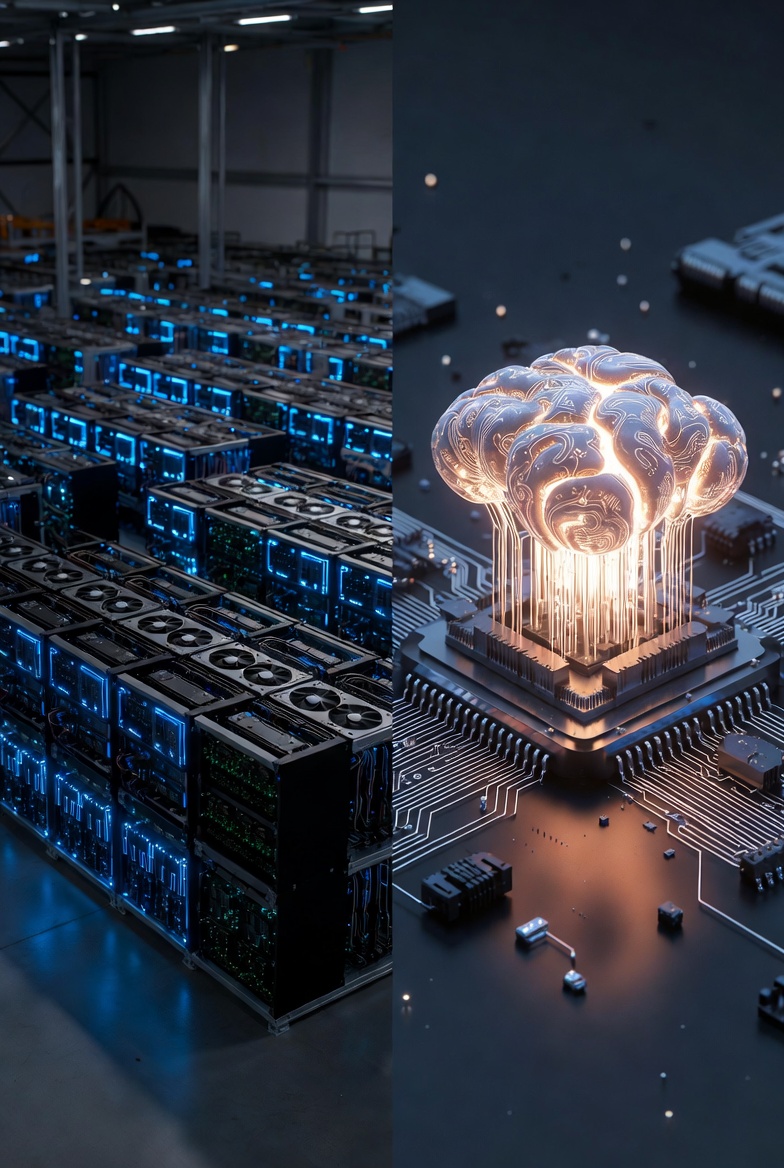
Biological neurons don't work that way. Your brain uses roughly the same amount of power as a dim light bulb — about 20 watts — while performing tasks that would require a warehouse full of servers to replicate. It doesn't run on raw horsepower. It runs on something closer to elegant efficiency.
What Cortical Labs demonstrated is that this efficiency isn't just a curiosity. It's usable. 200,000 neurons — a speck compared to the 86 billion in your brain — can learn a task that traditional programming would struggle to handle. Not because they're powerful in the conventional sense, but because they're adaptive in a way silicon hasn't been.
Researchers running a separate project mapped out the entire nervous system of a fruit fly — 86,000 neurons — and simulated it on a computer. The simulated fly exhibited walking behaviors. Nobody taught it to walk. The structure of the neural network, shaped by millions of years of evolution, contained the instruction set already. The engineers just switched it on.
The implication is startling: biology may be the most sophisticated AI training program ever built, and we're only beginning to read the code.
Why This Changes the AI Story
Here's where it gets relevant to you.
A lot of the anxiety about artificial intelligence — the layoff fears, the economic disruption scenarios, the doomsday forecasts — is built on a particular mental model of what AI is. People picture a system that keeps consuming more resources, more power, more human jobs, in an endless upward curve. A machine that scales by devouring.
The neuromorphic computing story — the shift from GPU-hungry models toward brain-inspired, energy-efficient architectures — tells a different story. One where AI becomes smaller, cheaper, more accessible, and more deeply embedded in the fabric of everyday life. Not a monolith at a data center. A tool in your doctor's office, your home, your car, your phone — running on a fraction of the power, making decisions in real time, without needing a fiber connection to a server farm in Nevada.
Think about what that means for healthcare alone. AI diagnostics that don't require a hospital's computing infrastructure. Drug discovery running on chips smaller than a thumbnail. Personalized treatment plans generated locally, privately, instantly. The healthcare cost crisis that keeps pre-retirees up at night looks very different in a world where the cost of biological computation is approaching zero.
And this week, the story took a significant step from the lab toward the real world. Cortical Labs — the same company behind the DOOM demo — just announced plans to build two biological data centers: one in Melbourne housing 120 CL1 units, and one in Singapore in partnership with a sustainability-focused data center firm. The CEO told Bloomberg that each CL1 unit uses less energy than a handheld calculator. For context, Google, Amazon, Microsoft, and OpenAI are spending billions of dollars building conventional data centers that require the electricity of entire neighborhoods. Cortical Labs is betting the future of computing infrastructure looks nothing like that.
This isn't speculation about 2050. The fruit fly simulation is real. The DOOM-playing neurons are real. The biological data centers are being built right now. And closer to home, the University of Texas at San Antonio just launched the nation's first open-access neuromorphic computing hub — funded by the National Science Foundation — making brain-inspired hardware available to researchers across the country for the first time. The trajectory is visible, it's moving faster than most people realize, and it's happening here.
What the Pessimists Are Missing (Again)
I've written before about the tendency to model disruption in high resolution and adaptation at zero resolution. The doomsday scenarios trace every link in the chain of destruction with precision — layoffs, spending drops, credit cracks — while the humans in those scenarios just sit there and absorb it.
The neuromorphic story is a perfect example of what those models ignore.
When one approach to AI hits a wall — energy costs, chip shortages, data limitations — the response isn't paralysis. It's innovation. Researchers look at the most sophisticated computing system ever observed (the human brain), reverse-engineer its architecture, and start building something better.
That's not a story about technology destroying the economy. That's the same story that played out with mechanized looms, electrification, and the internet — the story where the disruption turns out to be the engine of the next expansion, not the last chapter of the old one.
The people who read the ATM story in 1978 and concluded that bank tellers were finished missed the real headline: cheaper branches meant more branches, which meant more tellers for twenty years. The people reading the brain-cell-plays-DOOM story today and concluding that humanity is about to be automated out of existence are making the same mistake. They're looking at the disruption. They're not looking at what comes next.
What This Means for Someone Within 10 Years of Retirement
You don't need to understand the technical details of neuromorphic computing to benefit from what it implies.
Here's the short version.
AI is not on a path to catastrophe. It's on a path to becoming radically cheaper, more efficient, and more useful — in ways that are likely to reduce the cost of the things you're most worried about in retirement. Healthcare. Housing. Financial services. The infrastructure costs that drive prices higher are exactly what this generation of computing innovation is attacking.
That doesn't mean the transition will be smooth. Transitions never are. There will be real dislocation — industries restructuring, job categories evolving, businesses that fail to adapt falling behind those that do. We manage portfolios with that uncertainty in mind every day.
But managing for uncertainty is different from hiding from the future. The investors who have built the most lasting wealth across every technology transition in history are the ones who understood two things simultaneously: the disruption is real, and the adaptation is also real. The smart play is to be positioned for the transition — protected against the volatility it creates — while staying invested in the enormous value the other side of that transition will produce.
That's how we think about it at Asset Guidance Group. Our rules-based system monitors risk conditions continuously and adjusts positioning as conditions change — not to predict the future, but to manage the cost of being wrong about it. The goal is always the same: preserve enough capital to participate in what comes next.
And what's coming next, if the brain cells are any indication, is extraordinary.
Take Action
If you're reading this in your inbox — you got the full article, but the ❤️ heart button is hiding from you. It lives on the Substack website, along with the comment section and the share options. Click through to the post, tap the heart, leave a thought, or send this to someone who'd find it interesting. Every like helps The Lighthouse reach more readers who are asking the right questions about their future.
If this raised questions about your own positioning — whether your portfolio is built to navigate an AI-driven transition without getting derailed by the volatility it creates — I'd welcome that conversation. Reply to this email, call the office, or schedule a review here. No pitch, no pressure. Just an honest look at where you stand.
Investing involves risk, including the possible loss of principal. This article is for informational purposes only and does not constitute personalized investment advice. Past performance is not indicative of future results.
Wallace R Nichols, MBA, JD, CFP Chief Investment Officer Asset Guidance Group, LLC, a registered investment advisor
This post originally appeared on The Lighthouse on Substack. Subscribe for free to get new posts delivered to your inbox.